Teen Sentenced to 452 Years in Prison? The Viral Story Behind the Photograph
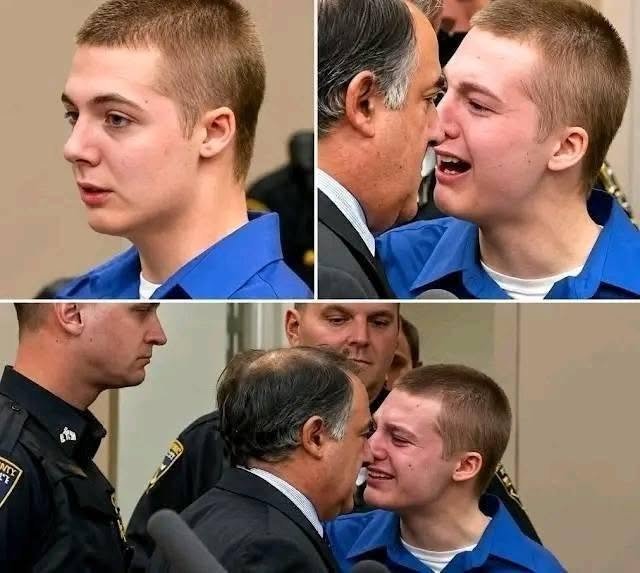
A photograph circulating online shows a young defendant in tears as an older man appears to speak closely to him in a courtroom. The accompanying headline claims:
“Teen Sentenced to 452 Years in Prison After He Ra…”
The image is powerful—and the story attached to it is even more shocking.
But there is a problem: the viral 452-year claim does not appear to be supported by reliable evidence. Recent fact-checking reports say the image/video has been circulating with misleading captions and that there is no verified court record establishing the claimed 452-year sentence in the case being portrayed. (Factually)
How Did the “452 Years” Story Begin?
The claim appears to have spread through social-media posts and websites using dramatic courtroom footage and sensational narration.
Different versions tell different stories. Some claim the teenager was convicted of numerous violent offenses and received consecutive sentences totaling 452 years. Others provide elaborate details about the defendant, victims and courtroom proceedings.
The problem is that these versions don’t consistently identify a defendant, court, case number, judge or reliable original news report.
Those missing details are a major warning sign when evaluating a sensational criminal-justice story.
Why Would a Sentence Be Hundreds of Years?
The concept itself isn’t impossible.
In jurisdictions where a defendant is convicted of multiple offenses, courts can sometimes impose separate sentences and order some of them to run consecutively. When dozens of counts are involved, the mathematical total can become extraordinarily large—even hundreds of years.
That doesn’t necessarily mean anyone expects the person to literally live for hundreds of years. The aggregate number can function as an extremely long period of incarceration.
There have been genuine cases involving juveniles receiving extraordinarily long sentences. For example, Bobby Bostic received a 241-year sentence as a teenager, although his case is entirely separate from the viral 452-year claim. (GoGoSpoiler –)
The Photograph Doesn’t Prove the Headline
This is an important lesson about viral content.
A photograph can be completely authentic while the caption attached to it is false or misleading.
That’s particularly common with courtroom photographs. A dramatic image of a crying defendant can easily be paired with an unrelated story, causing viewers to assume that the photograph itself proves the accompanying claims.
In this case, available fact-checking indicates that the viral 452-year narrative has been presented with misleading or fabricated context. (Factually)
Why Stories Like This Spread So Quickly
A headline such as “Teen Sentenced to 452 Years” immediately raises emotional questions:
- What did he do?
- Why was the punishment so extreme?
- Should teenagers receive effectively lifelong sentences?
- Can someone who commits a terrible crime as a teenager ever truly change?
Those are legitimate questions.
But they deserve answers based on court records and reputable reporting, not an anonymous social-media caption.
The Bottom Line
The claim that the teenager shown in the viral material was sentenced to 452 years in prison should not be presented as established fact.
The image may be real, but the sensational story attached to it is not reliably verified. Current fact-checking indicates that the 452-year claim is false or seriously misleading. (Factually)
Before sharing a shocking courtroom story, check the defendant’s name, court, case number and original reporting. A dramatic photograph isn’t evidence of the story written underneath it.