Jane Fonda and the “Hanoi Jane” Legacy: Why the Controversy Still Hasn’t Gone Away
Few Hollywood controversies have lasted as long as the one surrounding Jane Fonda’s activism during the Vietnam War.
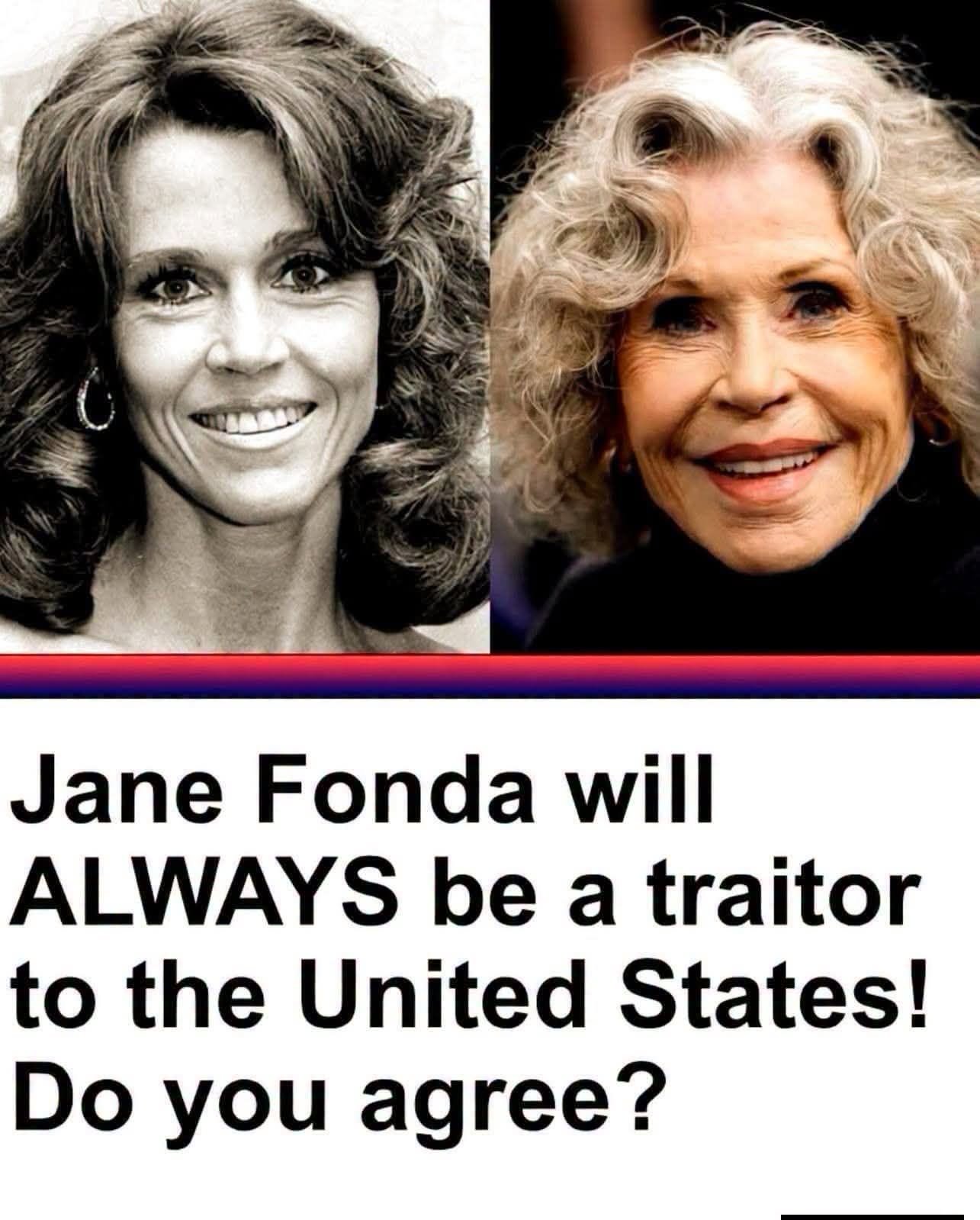
Decades later, the name “Hanoi Jane” still provokes anger among some American veterans and their families. A viral image now asks whether Fonda will “always be a traitor to the United States.” That wording is an opinion, not an established legal fact—but the history behind the anger is real.
The photograph that changed everything
In 1972, Fonda traveled to North Vietnam during the Vietnam War as part of her outspoken opposition to U.S. military involvement.
During that trip, she was photographed sitting on a North Vietnamese anti-aircraft gun. The photograph became one of the most infamous images associated with American opposition to the war and helped cement the “Hanoi Jane” label. (Military Times)
For many American service members, the photograph was viewed as a profound insult. Seeing an American celebrity sitting on a weapon associated with shooting at U.S. aircraft was interpreted as siding with the enemy.
That interpretation followed Fonda for decades.
Fonda has acknowledged the seriousness of the mistake
There is an important part of the story that viral posts sometimes leave out.
Fonda has repeatedly expressed regret for the anti-aircraft-gun photograph. In 2018, she described the decision to sit on the gun as thoughtless and acknowledged the painful message the image conveyed to American soldiers and their families. (Military Times)
Her position, however, has been more complicated than simply renouncing her entire anti-war movement.
Fonda has continued to defend her opposition to the Vietnam War while acknowledging that the photograph was a terrible mistake. She has described the image as something she regrets deeply and has apologized for the hurt it caused veterans. (TheWrap)
That distinction is important.
Was Jane Fonda a “traitor”?
This is where history and political judgment collide.
Calling someone a “traitor” is not merely criticism of their political views. Treason is a specific constitutional offense in the United States, with a very narrow legal definition.
Fonda’s actions during the Vietnam War were intensely controversial, but describing her as a “traitor” is ultimately a political or moral judgment unless one is making a specific legal claim.
That doesn’t mean veterans have to forgive her.
People who served in Vietnam can reasonably view her actions as deeply offensive, particularly given the circumstances and symbolism of the famous photograph.
At the same time, historical accuracy requires separating documented events from some of the more extreme stories that have circulated about Fonda for decades.
Some claims about “Hanoi Jane” go beyond the evidence
Over the years, numerous allegations have circulated online claiming that Fonda personally abused or interrogated American prisoners of war.
Those stories have been challenged by historians and others familiar with the historical record. One detailed historical examination found no evidence supporting some of the most sensational POW-abuse allegations repeatedly attributed to her. (HNN)
That doesn’t erase the documented controversy surrounding her trip to North Vietnam, her broadcasts and the anti-aircraft-gun photograph.
It does mean that the strongest criticism is also the criticism that sticks closest to the facts.
Why the controversy survives
Fonda’s political activism did not end with Vietnam.
Over subsequent decades, she became involved in a wide range of political and social causes, including women’s rights, Native American issues and environmental activism. Her activism has remained an important part of her public identity. (TIME)
For supporters, that history represents decades of activism on issues they believe are important.
For opponents, it reinforces the image of a wealthy Hollywood celebrity repeatedly using her platform to challenge American institutions and policies.
The Vietnam controversy remains particularly powerful because it involves something more personal than an ordinary political disagreement: American service members at war.
Can an apology erase the past?
That’s ultimately a question each person has to answer for themselves.
An apology can acknowledge wrongdoing. It can demonstrate that someone understands why their actions caused pain. But an apology doesn’t force the people who were hurt to forgive.
Fonda has apologized for the photograph and has repeatedly said she regrets the message it sent to American troops. (Military Times)
Whether that is sufficient is a matter of personal judgment.
Some veterans may accept the apology. Others may never do so.
Both reactions can exist without changing the historical record.
The image says one thing. History says something more complicated.
The viral graphic asks a simple question: Will Jane Fonda always be a traitor?
A more historically responsible question is harder:
How should Americans remember a famous anti-war activist whose actions deeply offended American troops, but who later acknowledged and apologized for at least some of those actions?
There is no requirement that Americans admire Fonda. There is equally no requirement that veterans forget what happened.
But remembering history accurately matters.
The anti-aircraft-gun photograph was real. The anger it generated was real. Fonda’s anti-war activism was real. And so were her later expressions of regret for the photograph.
Whether those facts amount to permanent condemnation is ultimately a matter of judgment—not something a viral meme can settle.
The lesson may be less about whether someone deserves a label forever and more about how seriously we should take the consequences of political activism, especially when symbolism and war collide.