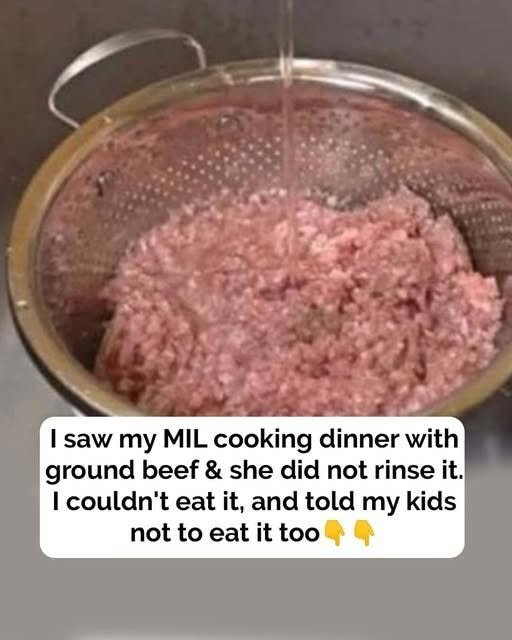
I Saw My Mother-in-Law Cooking Ground Beef Without Rinsing It—So I Refused to Eat It. Then Experts Weighed In
I thought I knew how to prepare ground beef safely.
So when I walked into my mother-in-law’s kitchen and saw her cooking ground beef straight from the package, I immediately noticed something.
She hadn’t rinsed it.
I was stunned.
In my own kitchen, I’d always rinsed ground beef before cooking it. In my mind, rinsing removed anything unpleasant that might have been left on the meat.
So when dinner was served, I hesitated.
I couldn’t bring myself to eat it.
I even told my children not to eat the beef.
But then I started wondering:
Had I been doing this wrong all along?
I decided to find out what food-safety experts actually recommend.
And the answer surprised me.
The advice is surprisingly clear
According to the USDA and CDC, you should not rinse raw ground beef before cooking it.
The reason isn’t that rinsing is unnecessary because the meat is magically free of bacteria.
It’s because washing raw meat can actually create another problem: cross-contamination.
When water hits raw meat, contaminated droplets can splash onto sinks, countertops, utensils, nearby food, or other surfaces. Instead of making the kitchen safer, rinsing can potentially spread bacteria around it. The USDA specifically recommends keeping raw ground beef separate from foods that won’t be cooked and washing hands and surfaces properly after handling it. (Food Safety and Inspection Service)
That completely changed the way I looked at my mother-in-law’s cooking.
She wasn’t being careless.
She was actually following the safer practice.
So how do you make ground beef safe?
The important step isn’t rinsing.
It’s cooking it thoroughly.
The CDC and USDA recommend cooking ground beef to an internal temperature of 160°F (71°C). A food thermometer is the most reliable way to determine whether it has reached that temperature. (CDC)
That’s particularly important with ground meat because grinding can distribute bacteria throughout the meat rather than leaving them only on the exterior.
Color isn’t a reliable substitute for a thermometer.
What about rinsing it after cooking?
Some people rinse or wash cooked ground beef because they want to remove excess grease.
That’s a different issue from food safety.
If you’re trying to reduce the amount of rendered fat, simply draining the cooked beef is generally the simpler approach. There is no food-safety requirement to rinse cooked ground beef.
And pouring water over meat isn’t going to make undercooked beef safe.
Heat is what matters.
The lesson I definitely didn’t expect
Looking back, I realize I had confused something that felt clean with something that was actually safer.
Rinsing raw meat seems logical.
You put something in the sink, wash it, and assume you’ve removed whatever might be harmful.
But raw meat isn’t like a vegetable you can simply rinse clean.
The safer approach is much simpler:
Clean your hands and surfaces. Keep raw meat away from ready-to-eat food. Then cook the beef thoroughly.
The CDC’s food-safety guidance boils the process down to four basic principles: Clean, Separate, Cook and Chill. (CDC)
So that night, I learned something I honestly wish I’d known years earlier.
My mother-in-law hadn’t forgotten an important step.
I had.
And before I ever tell my children that something isn’t safe to eat again, I’ll probably check what the food-safety experts actually say first.