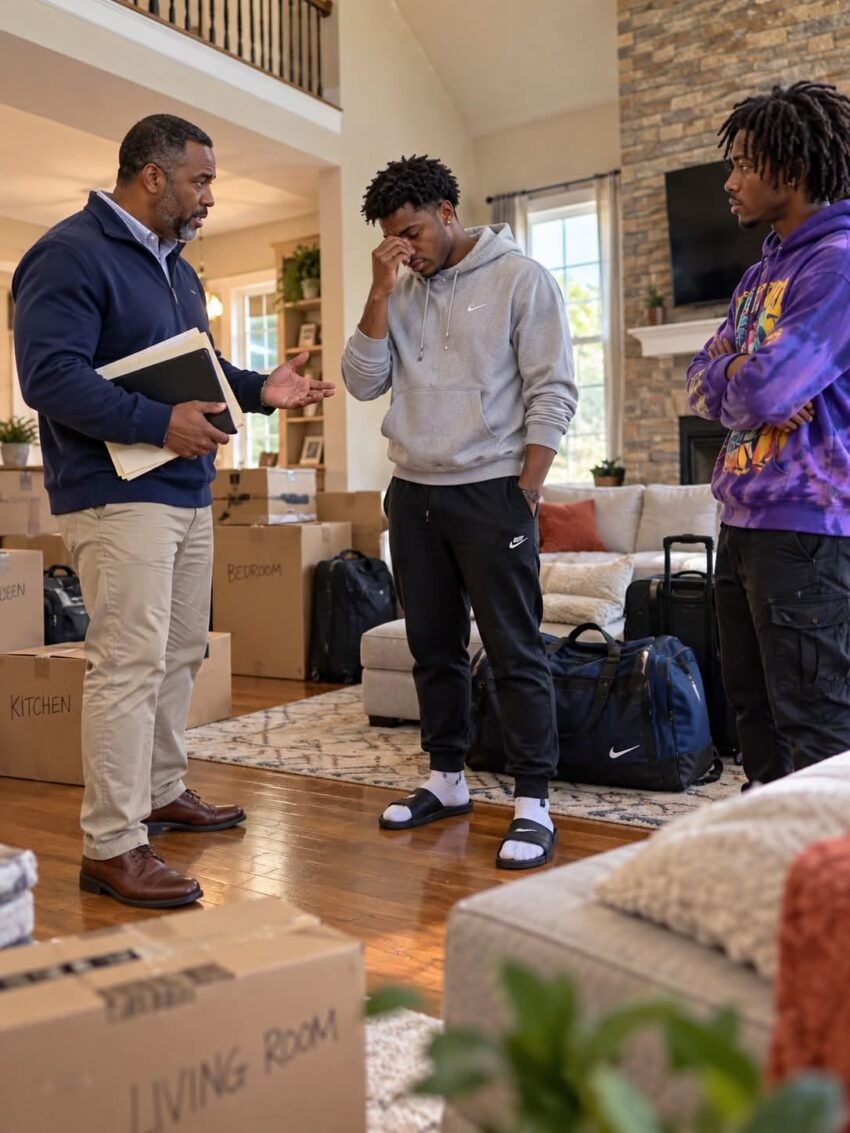
By the time my father finished speaking, I understood something I had spent eighteen years trying not to believe.
He wasn’t angry with me.
He wasn’t disappointed.
He simply didn’t care what happened to me.
I looked at Lorna, hoping—stupidly, perhaps—that she might say something. Anything. She kept her eyes on her coffee.
Dane smiled.
“Well, happy birthday, little brother.”
He wasn’t my brother. Not really. But for the past four years, I’d been expected to treat him like one while watching him get everything I’d been told we couldn’t afford for me.
His new phone. His driving lessons. His college application fees.
Apparently, my savings had helped pay for all of it.
I stood up so quickly that my chair scraped against the floor.
“You took money I earned.”
My father finally looked directly at me.
“And you lived under my roof.”
“That’s not what we agreed!”
He slammed his mug down.
“Don’t you dare raise your voice in my house.”
His house.
That was the phrase that finished it.
Not our house. Not the place where I’d grown up, where I’d measured myself against the height marks on the kitchen doorframe, where I’d sat alone on Christmas mornings waiting for everyone else to wake up.
His house.
I walked to the front door, picked up my three bags, and looked back one last time.
“You’re going to regret this.”
My father laughed.
“No, Jonah. You’ll regret it when you realize how difficult the world is without us.”
I left without answering.
I didn’t want him to see me cry.
The first night, I slept in my car behind the supermarket where I’d worked for nearly three years. I told myself it was temporary. I had a little fuel, a phone with a cracked screen, and enough pride to believe I could solve everything if I stayed calm.
The second night, I parked near my school and washed in the public toilets before class.
I told my teachers I was staying with a friend.
The third night, I stopped pretending I was fine.
My stomach hurt constantly. I was exhausted, and every time someone walked past my car, I woke up convinced they were coming to tell me to move.
But I kept going to school.
Three months.
That was all I needed.
Three months, and I could finish my exams. Maybe find a full-time job. Maybe rent a room somewhere.
I had survived eighteen years in that house. I could survive three months without it.
Then, on the seventh night, someone broke into my car.
They didn’t take much because I didn’t have much to take.
A cheap jacket. My schoolbag. The envelope containing my birth certificate and other documents.
But they also took the small amount of cash I’d managed to save from my first few shifts after leaving home.
I reported it to the police, but without an address or anyone willing to help me, there wasn’t much they could do.
On the ninth night, my car finally gave out.
I was driving toward school when the engine began coughing and the dashboard lights flashed. I managed to steer into a side street before the car rolled to a stop.
I turned the key again.
Nothing.
Again.
Nothing.
I sat there with both hands on the steering wheel, staring through the windshield.
Then I laughed.
Not because anything was funny.
I laughed because if I started crying, I wasn’t sure I’d ever stop.
That evening, the temperature dropped, and the wind cut through my thin jacket. I had eaten half a packet of crackers that morning and hadn’t had anything since.
I walked until I found a restaurant with a narrow alley behind it.
Warm air drifted through the back door whenever someone went in or out. I could smell roasted meat, bread, and something buttery that made my stomach twist.
I hated myself for being there.
I hated that I was eighteen years old, still in school, and looking behind a restaurant for something to eat.
But hunger doesn’t care about pride.
I waited until a kitchen worker came out carrying a black rubbish bag. When he went back inside, I approached the bins.
There were discarded bread rolls in a paper bag. Some untouched fries. A container of rice that looked as though it had barely been opened.
I reached for the bread.
“Jonah Keel?”
I froze.
The voice came from behind me.
It was calm, deep, and unmistakably directed at me.
I turned around.
A man stood near the alley entrance wearing a charcoal suit, a white shirt, and polished black shoes that looked absurdly clean beside the overflowing bins.
He was probably in his late forties. His hair was silver at the temples, and he held a black leather folder beneath one arm.
He looked at me for several seconds.
Then he said the words that would change the direction of my life.
“I’ve been looking for you.”
I instinctively stepped back.
“Who are you?”
“My name is Richard Hale.”
That meant nothing to me.
“Did my father send you?”
Something changed in his expression.
“Your father?”
“Look, if he wants me to come home, tell him he can forget it.”
Richard glanced at the food in my hands. He didn’t look disgusted. He didn’t look amused.
He looked heartbroken.
“No,” he said quietly. “Your father doesn’t know I’m here.”
I tightened my grip on the bread.
“Then what do you want?”
He opened his leather folder and pulled out a photograph.
It showed a younger man standing beside a woman in front of a small brick house. The woman was holding a baby wrapped in a blue blanket.
I stared at the photograph.
I recognized the woman immediately.
My mother.
She had died when I was six, and I had spent the following twelve years hearing almost nothing about her except that she had been a wonderful person and that talking about her upset my father.
But the man standing beside her wasn’t my father.
I had never seen him before.
“Where did you get that?” I whispered.
“Your mother gave it to me.”
I shook my head.
“That’s impossible.”
Richard took a slow breath.
“Jonah, your mother and I were very close. Before she died, she made me promise that if anything ever happened to her and you needed help, I would find you.”
My throat tightened.
“Then why did you wait eighteen years?”
His face fell.
“Because I believed you were safe.”
He opened the folder again and showed me a document with my full name printed across the top.
Below it was my mother’s signature.
I recognized the handwriting from the birthday cards she’d written when I was little, the ones my father had kept in a drawer.
Richard continued.
“Your mother established a trust for you before she died. She arranged for it to become accessible when you turned eighteen.”
I stared at him.
“A trust?”
“Yes.”
“How much?”
He hesitated.
Then he told me a figure that made the alley seem to tilt beneath my feet.
I thought I’d misheard him.
“That’s not possible.”
“It is.”
“My father said we had no money. He said my mother left us with debts.”
Richard’s jaw tightened.
“Your mother left you with security. Someone made sure you never knew about it.”
For the first time in nine days, I forgot that I was hungry.
“Who?”
Richard looked at me for a long moment.
Then he lowered his voice.
“That’s what I’ve spent the last several months trying to establish. And I believe the answer is connected to the people who threw you out of their house this morning.”
My hands began to shake.
I thought about my father sitting at the kitchen table. Lorna stirring her coffee. Dane smiling while my father admitted to taking every dollar I’d saved.
I thought about the three bags by the door.
Then I looked again at my mother’s photograph.
“Why are you telling me this now?”
“Because your eighteenth birthday activated the trust. And because, nine days ago, a financial institution contacted me about a transaction connected to your name.”
He turned the document toward me.
At the bottom was a signature I recognized instantly.
My father’s.
Richard closed the folder.
“Jonah, I need you to understand something. The money your father took from you may be the smallest part of what he’s done.”
I stared at him, unable to speak.
Then Richard removed his coat and placed it over my shoulders.
“Come with me,” he said. “There’s a warm meal waiting, a room where you can sleep, and a lawyer who needs to hear your story.”
I looked toward the restaurant door.
Then back at the photograph of my mother.
For nine nights, I’d believed my life was falling apart because I’d been abandoned.
Now I was beginning to wonder whether someone had been working very hard to keep me exactly where I was.
I followed Richard out of the alley.
But as we reached his car, he stopped and turned toward me.
“One more thing, Jonah.”
“What?”
“The trust wasn’t just money.”
He opened the passenger door.
“Your mother left you something else. Something your father has spent twelve years trying to get his hands on.”
And when he told me what it was, I finally understood why my eighteenth birthday hadn’t been a celebration.