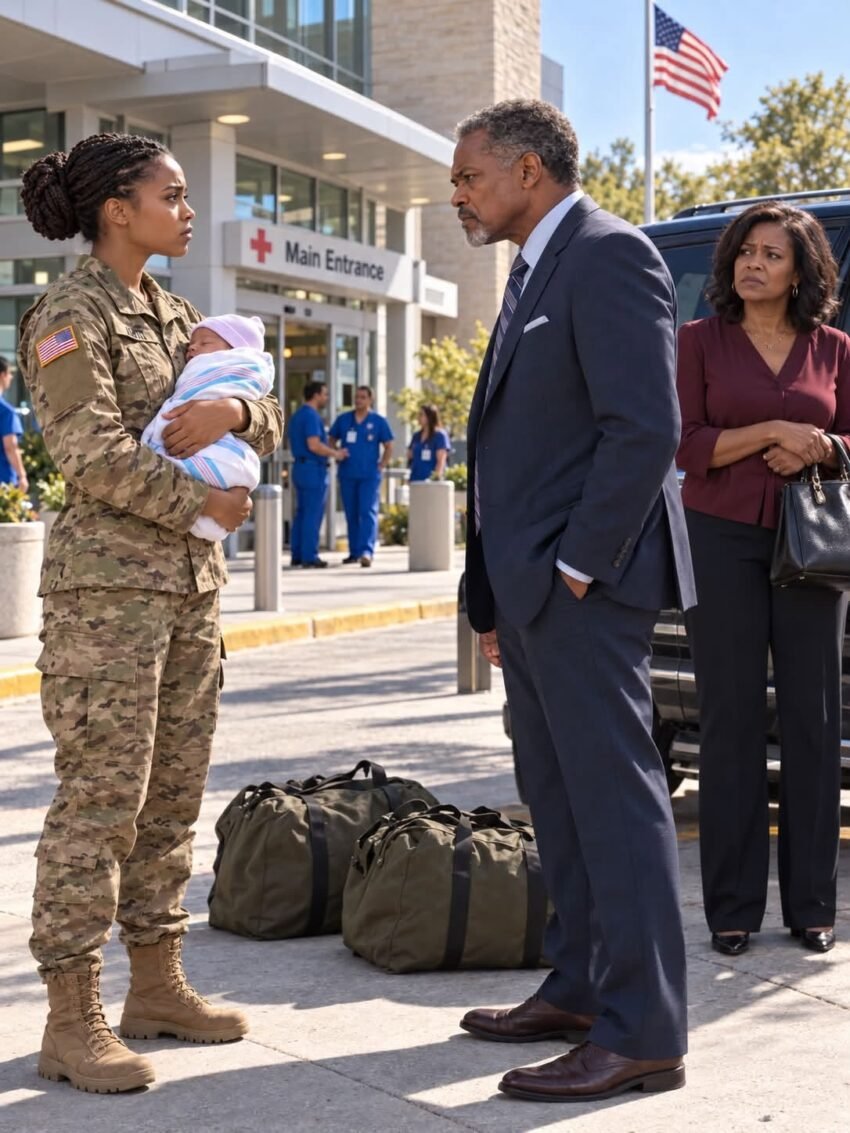
The siren stopped directly behind my father’s Silverado.
He froze with his keys halfway to the driver’s door.
My mother turned first.
Two military police officers stepped out of the patrol vehicle. Behind them came Major Thomas Sterling, wearing his dress uniform, his expression colder than I had ever seen it.
My father straightened his jacket.
For one brief second, he looked almost relieved.
He probably thought the officers had come to help him deal with his unreasonable, grieving daughter.
Then Major Sterling walked straight past him.
He stopped beside me.
“Ma’am, are you and your daughter safe?”
I nodded, although my hands were trembling so badly that I had to press my palm against the hospital bag.
“My daughter is safe. I just had nowhere to go.”
Sterling looked at the pavement, at my bags, and at the tiny baby wrapped against my chest.
His jaw tightened.
“Understood.”
Then he turned toward my father.
“Sir, step away from that vehicle.”
My father gave a short, disbelieving laugh.
“Excuse me? This is a family matter.”
“No, sir. Not anymore.”
“You don’t have any authority over me.”
One of the military police officers stepped forward.
“Sir, we need you to step away from the vehicle while we establish what’s happening.”
My father glanced at my mother.
She immediately found her voice.
“This is ridiculous. Our daughter has just lost her husband. She’s exhausted, medicated, and clearly not thinking straight. We’re taking her home to look after her.”
I watched Major Sterling’s expression change.
“Your daughter has just told me she does not consent to going with you.”
My mother opened her mouth.
Nothing came out.
My father pointed at me.
“She’s confused. She doesn’t understand what she’s doing. I’ve been managing her affairs for years.”
Sterling didn’t raise his voice.
“Then you should have no difficulty explaining why you attempted to redirect her husband’s life insurance benefit into a business account that does not belong to her.”
The silence that followed was extraordinary.
My father’s face drained of color.
My mother looked at him.
Not at me.
At him.
And that was when I knew she hadn’t been surprised by the accusation.
She had been afraid of hearing it spoken aloud.
“That’s a lie,” my father snapped. “I was trying to protect my granddaughter.”
“Then you won’t object to providing the relevant paperwork to the casualty assistance office.”
“I don’t have to show you anything!”
“You’re correct,” Sterling replied. “But you also have no authority to take your daughter’s property or represent yourself as her financial proxy without proper authorization.”
My father looked toward his truck.
The green folder was still sitting on the dashboard.
“That folder belongs to my family.”
“No,” I said quietly. “It belongs to me.”
He turned on me.
“You ungrateful little—”
“Sir,” one of the officers interrupted sharply. “That’s enough.”
My daughter stirred against my chest.
I immediately lowered my face to hers and whispered that everything was all right, even though I was still standing on a hospital pavement three days after major surgery, with nowhere to sleep and no idea what would happen next.
Major Sterling noticed.
He took off his uniform jacket and draped it around my shoulders.
“Let’s get you somewhere safe.”
My father stepped forward.
“You can’t take her!”
Sterling looked him directly in the eye.
“I’m not taking anyone anywhere against their wishes. Your daughter is an adult. She’s free to decide where she goes.”
Then he glanced at the military police.
“Please document the situation and the reported possession of the benefit documents. We’ll coordinate with the appropriate offices and civilian authorities.”
My father began shouting about lawyers.
My mother started crying.
And Derek, my younger brother, appeared at the far end of the drop-off lane.
He had apparently followed the whole thing from his car.
For a moment, I thought he might walk over and defend our parents.
Instead, he approached me with his head bowed.
“I’m sorry,” he whispered.
I stared at him.
“For what?”
He swallowed.
“Because I knew they were planning to leave you here. I knew about the papers. I should have told you sooner.”
I wanted to be angry.
Part of me was.
But I was too tired to carry another person’s guilt.
“Just tell the truth when they ask you what happened,” I said.
He nodded.
“I will.”
Then Major Sterling helped arrange transportation for me and my daughter through the military family assistance office. A staff member contacted the appropriate support personnel, and before long, I was no longer standing alone beside the hospital entrance.
For the first time since David’s death, somebody was asking me what I needed instead of telling me what I owed them.
But the worst discovery was still waiting.
Two hours later, I sat in a quiet room with my daughter sleeping in a bassinet beside me. A casualty assistance officer joined us by phone while Major Sterling reviewed the information I’d provided.
She spoke carefully.
“Your husband’s SGLI benefit has not been paid to your father’s business account. The attempted change was not authorized, and the funds remain subject to the proper beneficiary process.”
I closed my eyes in relief.
Then she continued.
“There’s another issue. Your father contacted our office before your husband was buried. He represented himself as someone authorized to manage your affairs.”
I looked at Sterling.
“How could he do that?”
“He couldn’t simply appoint himself,” the officer explained. “But he submitted documents claiming you had authorized him to act on your behalf.”
My stomach tightened.
“What documents?”
There was a pause.
“We’re reviewing the submission. Some of the signatures appear inconsistent with the records we have.”
I thought about the power of attorney form my father had slapped onto my hospital tray.
I remembered the way he had smiled when I picked up the pen.
And I remembered the green folder David had given me before deployment.
“Did he take anything else from my husband’s belongings?” I asked.
Sterling looked down at his notes.