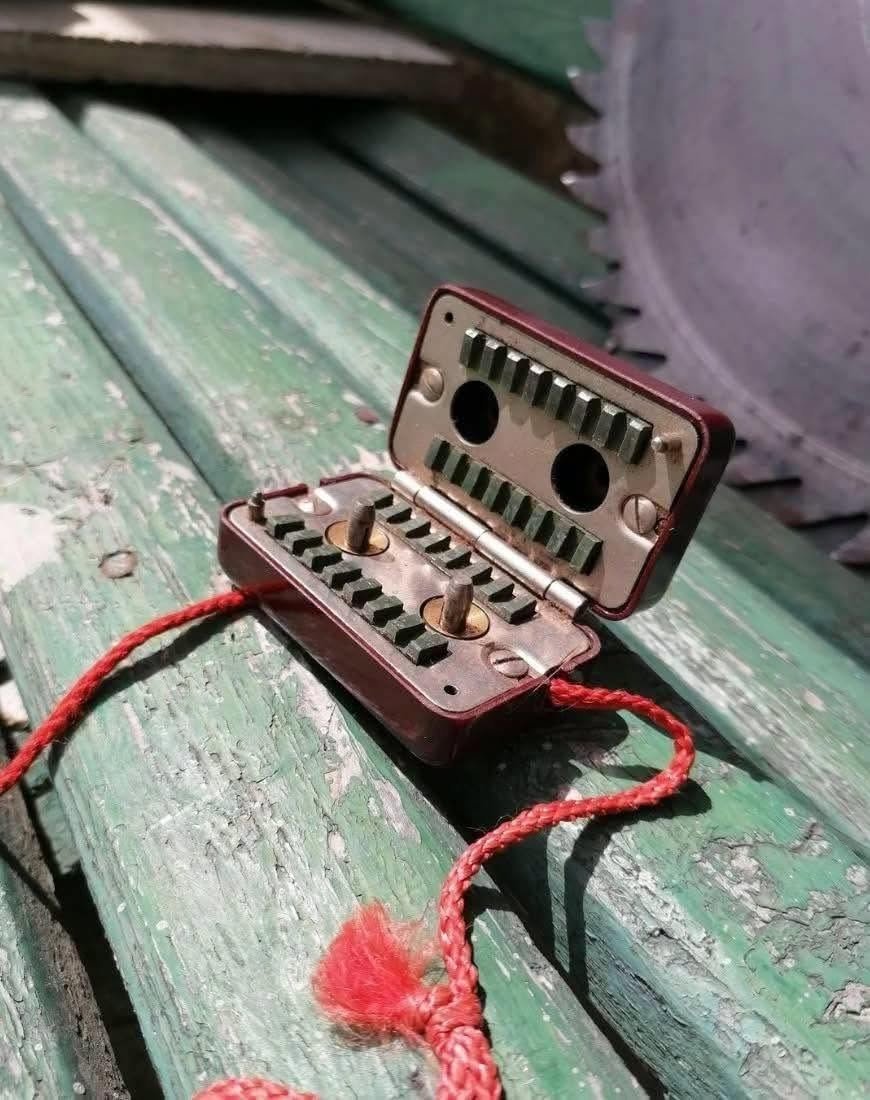
Found in a 1914 House: What Is the Strange Siemens Device With the Red Cord?
If you find an unusual little device in an old house, it’s easy to assume it was part of the home’s electrical or telephone system.
But if yours is marked Siemens, has a red cord, and contains small brass or gold-colored pins that spin when you pull the cord, there’s a much more interesting explanation.
It appears to be a vintage Siemens razor-blade sharpener.
That’s right—not an electrical switch or mysterious piece of house wiring.
A razor sharpener from another era
Before disposable razor cartridges became commonplace, people routinely reused their razor blades.
A sharp blade was valuable, and keeping it in good condition could save money.
The Siemens device was designed to help with exactly that.
According to a description of an example matching these unusual features, the device has a red cord and two brass pins that rotate when the cord is pulled. That mechanism causes a razor blade mounted inside to move back and forth against sharpening surfaces. (Good Old Days)
In other words, the strange little machine converts a simple pull of a cord into a rapid mechanical sharpening motion.
Why does the cord make the pins spin?
The mechanism is the clever part.
Pulling the cord causes an internal rotating mechanism to turn. The small brass-colored pins are part of that mechanism.
The motion isn’t intended to accomplish anything in the house itself. Instead, it drives the razor-sharpening action inside the device.
It’s essentially a tiny mechanical machine powered by your hand.
No batteries.
No electricity.
No motor.
Just a cord, gears or rotating components, and mechanical momentum.
Why would it be in a 1914 house?
The age of the house makes the discovery especially fascinating, but it doesn’t necessarily mean the sharpener was installed when the house was built.
A house constructed in 1914 could have accumulated household objects for decades afterward. Someone may have purchased the Siemens sharpener years later and simply kept it in a bathroom, bedroom, or cabinet.
And Siemens was certainly manufacturing a wide range of sophisticated technology during this general period. Historical collections document Siemens & Halske equipment from the early 20th century, including telecommunications equipment from around 1914–1918. (Science Museum Group Collection)
So the Siemens name itself isn’t evidence that the object was part of the home’s original infrastructure.
A fascinating glimpse into everyday life
What makes objects like this so interesting is that they reveal how different ordinary life once was.
Today, someone with a dull razor generally throws it away and reaches for another.
A century ago, replacing an item wasn’t always the default.
People maintained things.
They sharpened blades.
They repaired appliances.
They reused household goods.
And manufacturers created ingenious little machines to make those jobs easier.
This Siemens sharpener is a perfect example of that philosophy.
So, what is it?
Most likely, it’s a Siemens mechanical razor-blade sharpener.
The red pull cord powers the internal mechanism, while the rotating brass-colored components drive the sharpening action. The distinctive combination of the Siemens branding, red cord, and spinning brass pins is a strong match for documented examples of this unusual antique device. (Good Old Days)
It’s a wonderful little reminder that some of the strangest objects in old houses aren’t mysterious electrical relics at all.
Sometimes they’re simply clever solutions to everyday problems that modern technology has made us forget existed.