Here’s a polished, curiosity-driven blog version:
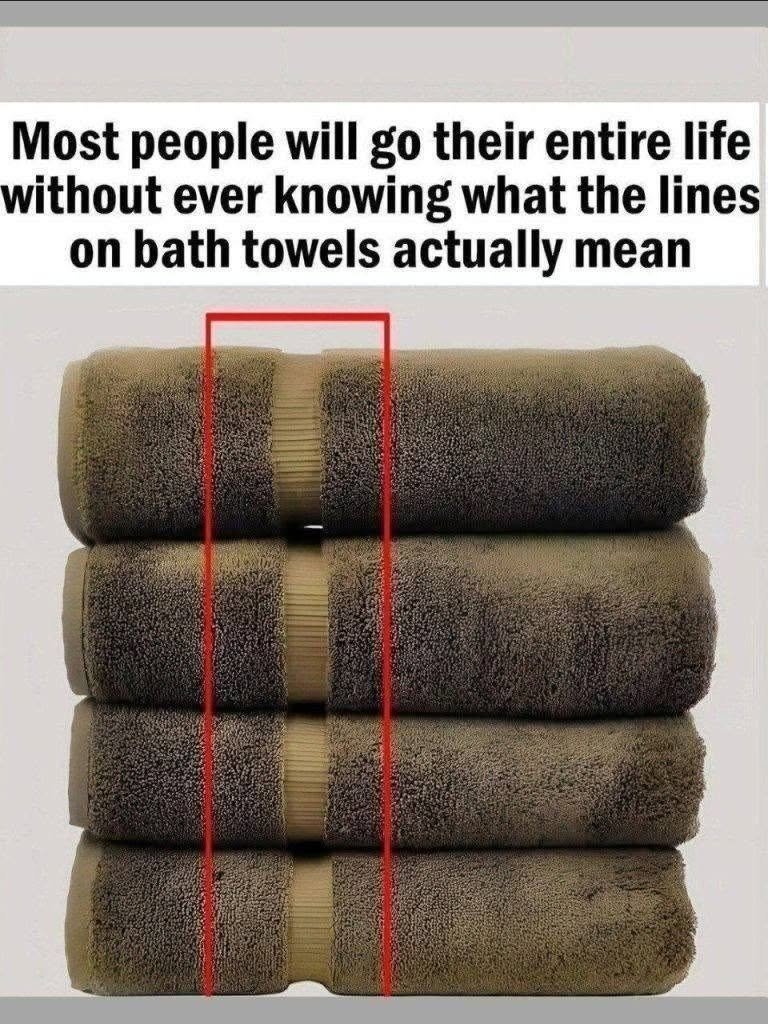
Here’s What the Lines on Bath Towels Actually Mean
Have you ever looked closely at a bath towel and wondered why it has those strange horizontal lines or raised bands woven into the fabric?
Most people probably never give them a second thought.
But those lines actually have a purpose.
They’re commonly called dobby borders or dobby stripes, and they’re created as part of the towel’s weaving pattern.
They Help Give the Towel Structure
The decorative band isn’t just there to make a plain towel look more interesting.
The tighter weave in that section can help stabilize the towel’s edges and provide a transition between different parts of the fabric.
Without some kind of structured border, a towel’s edges can be more prone to losing their shape or curling as the fabric is washed and dried repeatedly.
They’re Also Decorative
Let’s be honest—towels would look pretty boring if they were nothing but one continuous field of loops.
The woven bands create a visual break between the absorbent terry sections and the edge of the towel.
That’s why you’ll see everything from simple raised stripes to elaborate geometric patterns.
Why Aren’t the Lines as Soft?
Run your hand across the towel and you’ll probably notice something else.
The striped section often feels flatter and less fluffy than the rest of the towel.
That’s because it isn’t made with the same dense loops of terry fabric.
The main body of the towel is designed to maximize surface area and absorb water, while the border uses a different weave that creates a smoother, more compact surface.
Do the Lines Make the Towel More Absorbent?
Not really.
The fluffy terry portion does most of the water-absorbing work.
The woven bands are primarily structural and decorative rather than an extra absorbent layer.
And There’s One More Interesting Detail
Those stripes can also make towels easier to fold and stack neatly.
The border provides a natural visual reference, making it easier to align towels in linen closets, hotels, spas, and stores.
So the next time you grab a towel after a shower, take a closer look.
Those seemingly random lines aren’t random at all.
They’re a small example of how everyday objects are often designed with several purposes in mind.
What looks like decoration may actually be part of the engineering.