“I Am an Illegal Immigrant — Should I Be Deported?”: The Question Behind a Viral Immigration Image
A provocative image appearing online is designed to stop people in their tracks.
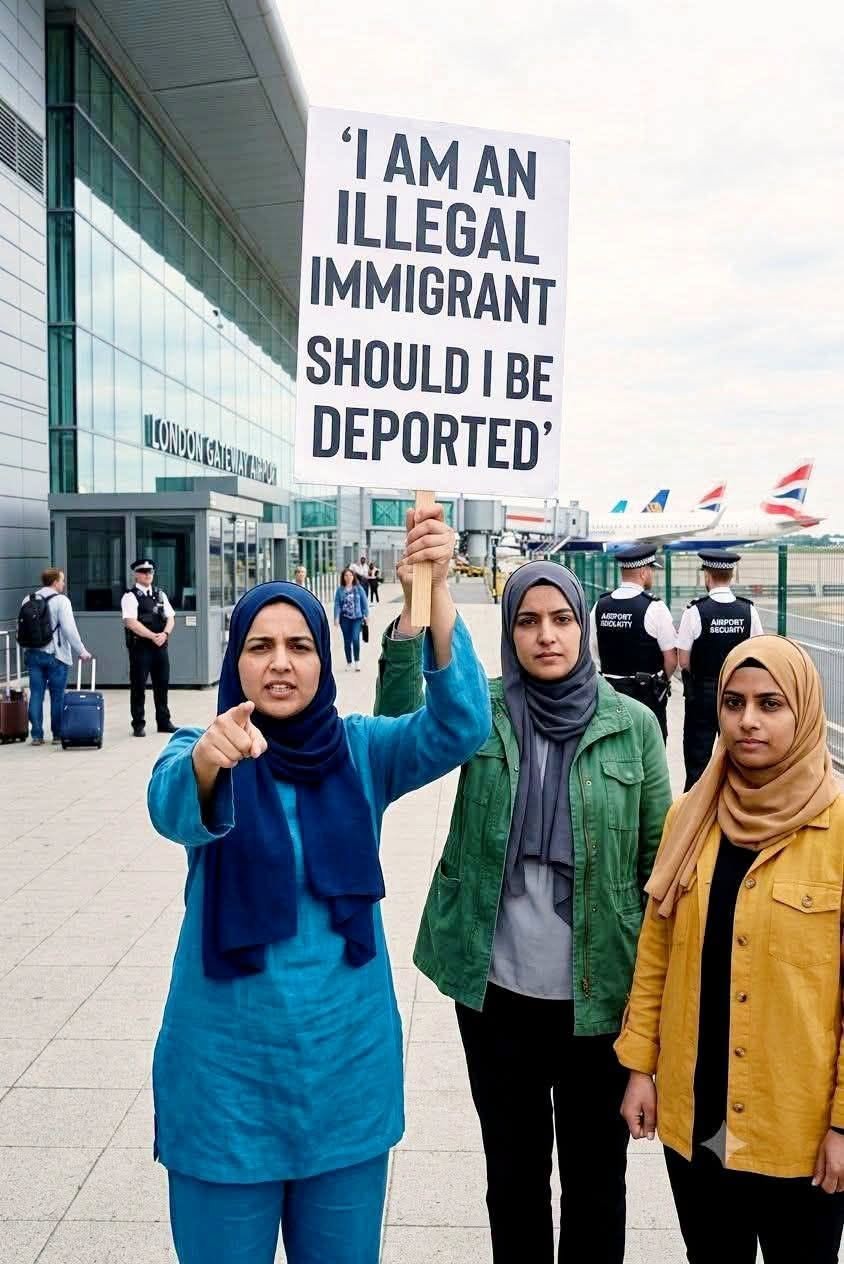
Outside what appears to be London Gatwick Airport, three women stand together while one holds a large sign asking:
“I AM AN ILLEGAL IMMIGRANT. SHOULD I BE DEPORTED?”
The image immediately raises a much bigger question: What should happen when someone is living in a country without lawful immigration status?
It is a question that sits at the center of one of the most emotionally charged political debates in Britain and many other countries.
A question with no simple answer
Immigration law generally distinguishes between people who have legal permission to remain in a country and those who do not.
But the circumstances behind someone’s immigration status can be dramatically different.
A person might have overstayed a visa. Another might have entered without authorization. Someone else might be awaiting a decision on an asylum application. Another person may have lived in the country for years, built a family and community, and have children who are citizens.
Treating every situation as identical can therefore obscure the difficult human questions involved.
What does “illegal immigrant” actually mean?
The phrase itself is politically controversial.
Governments generally refer to people according to their legal immigration status—for example, an undocumented migrant, a person who has overstayed a visa, or someone who has no valid permission to remain.
That distinction matters because immigration status can change, and people can have legal avenues through which they challenge removal decisions.
Someone’s presence without valid immigration permission does not automatically tell us why they are there or what legal protections may apply to them.
Deportation is a legal process
The sign’s question—“Should I be deported?”—sounds like it has a simple yes-or-no answer.
In reality, removal from a country is normally governed by immigration law and administrative or judicial procedures.
Authorities may have to consider matters such as nationality, immigration history, criminal convictions, asylum or humanitarian claims, family circumstances and other legally relevant factors.
That means the question isn’t simply whether someone is “illegal.”
The more precise question is:
What does the law require in this person’s particular circumstances?
The human side of the debate
Immigration debates often become arguments about numbers, borders and government policy.
But every immigration case involves an individual.
People who favor strict enforcement argue that a country cannot maintain a credible immigration system if people who have no legal right to remain can stay indefinitely. They also argue that enforcing immigration law protects the integrity of legal migration and asylum systems.
Those who oppose aggressive deportation policies often emphasize family separation, humanitarian concerns and the possibility that vulnerable people could be returned to dangerous circumstances.
Both perspectives raise serious questions.
A functioning immigration system has to balance sovereignty and enforcement with due process and human considerations.
What the image doesn’t tell us
The photograph itself cannot establish whether the people pictured are actually undocumented immigrants.
Nor does holding a sign establish the immigration status of the person holding it.
Images shared online can be staged, satirical, digitally altered or created for political messaging. The words on a placard should therefore be treated as a statement or argument—not independent proof of the circumstances depicted.
That distinction is particularly important when emotionally powerful photographs are used to support political claims.
Where should the line be drawn?
The deeper disagreement is not necessarily about whether immigration laws should exist.
Most countries have immigration laws, border controls and procedures governing who can enter and remain.
The argument is about how those laws should be enforced.
Should people who violate immigration rules always be removed?
Should long-term residents receive consideration because of their family and community ties?
How should countries treat asylum seekers whose applications are still being decided?
How should governments distinguish between serious criminal offenders and people whose only immigration violation is overstaying a visa?
And how much discretion should immigration authorities have?
These are policy questions that cannot be answered by a single photograph.
The question worth asking
The viral sign asks:
“Should I be deported?”
Perhaps the more useful question for policymakers and the public is:
“What should a fair immigration system do when someone has no lawful status?”
A credible system needs clear rules. It also needs procedures that are transparent, consistent and capable of recognizing exceptional circumstances.
Enforcement without due process can produce injustice.
But laws without meaningful enforcement can also undermine public confidence in the immigration system.
The challenge is finding the balance.
And that is why an image as simple as three people standing outside an airport with a handwritten-looking question can ignite such a complicated debate.
Immigration is ultimately about more than borders. It is about law, security, fairness, opportunity and the lives of the people affected by those decisions.