Part 2: The Confrontation
The siren’s blare was deafening, but inside the ambulance, my focus was entirely on survival. The paramedic squeezed my hand tightly as the monitor beeped frantically.
“Stay with us, Rebecca,” he urged, his voice steady despite the tension in his eyes. “We’re five minutes out from the trauma center. Just keep breathing.”
When the doors burst open at the emergency room, the world devolved into sharp orders and flashing surgical lights. My doctor, who had repeatedly cautioned Ethan about my high-risk preeclampsia, was waiting at the bay. The moment she saw the blood and checked my vitals, her expression turned stern and resolute.
“Emergency C-section right now!” she commanded, running alongside my gurney. “Her pressure is through the roof, and fetal heart tones are dropping!”
In the operating room, I was sobbing, terrified, and completely alone without my husband. Within minutes, through the haze of medication and tears, a sharp, indignant cry filled the room.
“He’s here,” the nurse whispered, holding up a tiny, swaddled boy. “He’s small, Rebecca, but he’s strong.”
Our son was born four weeks premature and was immediately rushed to the Neonatal Intensive Care Unit (NICU). The surgeons stabilized my severe placental abruption—a life-threatening condition that could have taken both our lives within hours if I had waited as Ethan demanded.
The General’s Wrath
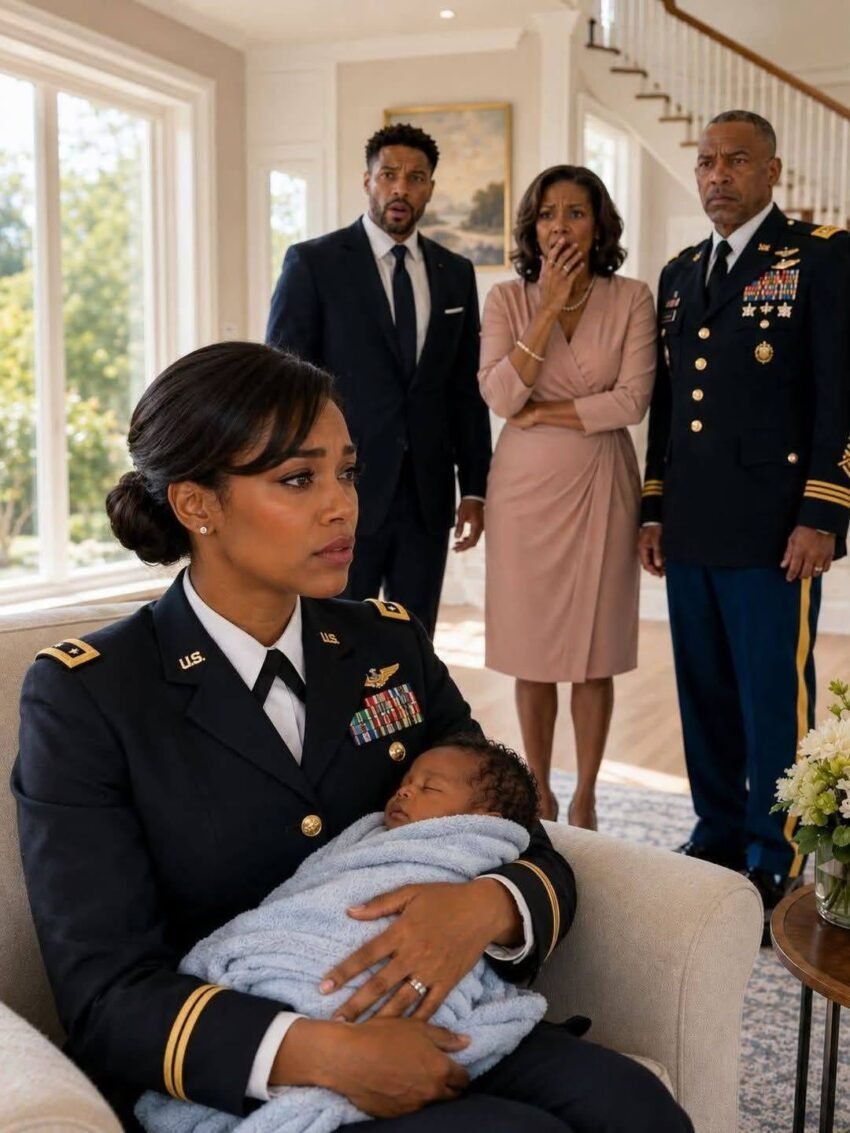
An hour later, my father arrived at the hospital. A retired three-star Army General who had served thirty-four years in military command, he stepped into the recovery room pale with worry. But as he looked at the IV lines hooked into my arms and learned that Ethan had abandoned me bleeding on the floor to go to a party, his concern transformed into an icy, unyielding rage.
“Where is he, Rebecca?” my father asked, his voice deceptively low.
“He went to his mother’s dinner,” I whispered, tears slipping down my cheek. “He turned off his phone.”
My father kissed my forehead gently. “Focus on resting and getting strong for your boy. I will handle Ethan.”
What Ethan had overlooked in his arrogance was that the suburban house we lived in was held by my family’s estate trust, and the luxury SUV he drove was registered to my father’s business holding group. While I spent the next two days recovering and holding my son in the NICU, my father set his plan into motion.
The Return Home
Two days later, Ethan finally returned. Having spent forty-eight hours celebrating with his mother, he was convinced I had merely thrown a dramatic tantrum. He expected to walk inside, find me sitting on the couch with the baby, and demand an apology for “trying to ruin” his weekend.
As he turned onto our street, he slammed on the brakes.
Filling our entire driveway, lawn, and front curb were three heavy military transport vehicles and two security details. Uniformed guards stood at full attention along the property line. Neighbors gathered on their porches, whispering and filming with their phones.
Ethan’s face went pale. He parked at the curb, adjusting his suit jacket, trying to maintain his composure as he walked up the driveway.
When he reached the front porch, two armed officers stepped forward, crossing their arms to block the entrance.
“What is the meaning of this? This is my house,” Ethan snapped, trying to sound authoritative.
The heavy front door swung open. My father stepped onto the porch in his full military dress uniform, flanked by two officers and a local deputy sheriff holding a thick stack of legal documents.
“It was your house, Ethan,” my father said, his voice echoing clearly down the street. “Until forty-eight hours ago.”
Ethan stammered, “What are you talking about? Where is Rebecca? Where is the baby?”
“The baby is in the NICU, recovering from an emergency surgery caused by a severe placental abruption,” my father replied coldly. “The exact medical emergency you walked away from while my daughter bled on the tile.”
Ethan froze, the color draining entirely from his face. “I… I thought she was overreacting…”
“You left a dying woman and your child to eat birthday cake,” my father spat. “So while you were celebrating, I took care of business.”
The sheriff stepped forward and handed Ethan the paperwork. “Ethan Vance, you are being served with an immediate emergency protection order, an order of eviction, and a petition for full legal custody and divorce. Your access to this property is revoked.”
“You can’t do this!” Ethan shouted, his voice cracking. “My clothes are in there! My car—”
“The car is company property,” my father interrupted calmly. “Hand over the keys.”
An officer held out his hand. Trembling, Ethan fumbled in his pocket and yielded the key fob.
“Your personal belongings have been packed into boxes by the gate,” my father added, pointing to a small stack near the sidewalk. “If you step foot on this property again, you will be arrested for felony trespassing. If you attempt to contact Rebecca or approach the hospital, you will be taken into custody immediately.”
Ethan looked around at the guards, the neighbors watching his disgrace, and my father’s unwavering gaze. Realizing he had lost everything in forty-eight hours, he picked up his cardboard boxes and began the long, humiliating walk down the street in his charcoal suit.
Three days later, I held my healthy baby boy in my arms and signed the final divorce papers. Supported by the 911 recording, hospital emergency logs, and proof of abandonment, the court granted me full legal custody with zero visitation rights, leaving Ethan to face the consequences of his choices alone.