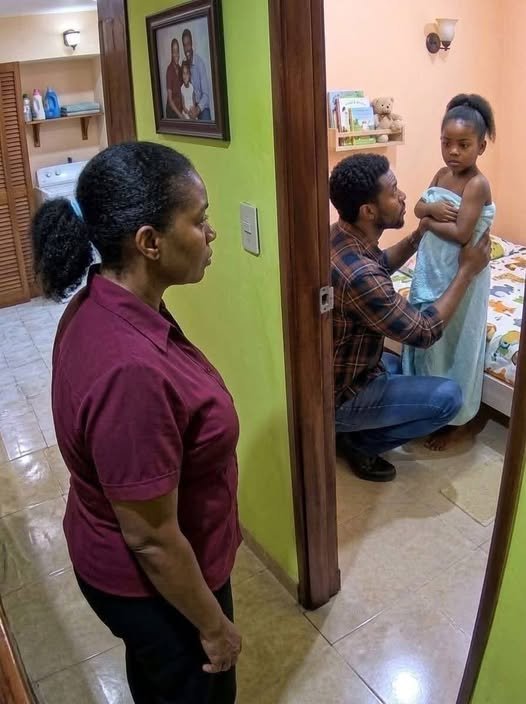
Alejandro was kneeling beside the bathtub, holding a washcloth in one hand. Sofía stood pressed against the wall, her little arms wrapped around herself.
She wasn’t crying loudly.
She wasn’t calling for me.
She was staring at the bathroom door.
At me.
And the look in her eyes was something I will never forget.
It wasn’t the look of a child who had been caught doing something wrong.
It was the look of a child who was terrified that someone had finally discovered her secret.
Alejandro turned.
When he saw me, his expression changed for just a moment. Then he smiled as though nothing unusual had happened.
“You’re home early, cariño.”
I barely heard him.
My eyes were fixed on my daughter.
“Sofía, sweetheart, come to Mommy.”
She didn’t move.
Alejandro stood up.
“She’s fine. We were just finishing her bath.”
I took one step into the bathroom.
“Get away from her.”
His smile disappeared.
“What?”
“I said, get away from my daughter.”
For the first time since I’d married him, Alejandro looked at me as if he didn’t recognize me.
Then he laughed nervously.
“You’re making a scene over nothing. She’s just being difficult tonight.”
Sofía flinched when he moved toward her.
That tiny movement told me more than a hundred explanations ever could.
I rushed forward, wrapped a towel around my daughter, and lifted her into my arms.
She clung to my neck so tightly that her little fingers hurt.
“It’s okay, mi amor,” I whispered. “Mommy’s here.”
Alejandro followed us into the hallway.
“Put her down. You’re upsetting her.”
I turned to face him.
“Don’t come near us.”
His expression hardened.
“You have no idea what you’re doing. I’ve been helping you raise this child while you work all day. You should be thanking me.”
I looked at Sofía.
Her face was buried against my shoulder.
Then I looked back at the man I’d trusted with the most precious thing in my life.
“Pack your things,” I said. “You’re leaving this house.”
He stared at me.
“You can’t throw me out because of a misunderstanding.”
I didn’t argue.
I didn’t need to understand every detail that night to know that my daughter was frightened and needed to be protected.
I carried her into my bedroom, locked the door, and called my older sister, Mariana.
“Please come,” I whispered. “Bring someone if you can. I need help.”
She heard something in my voice and didn’t ask questions.
“I’m on my way.”
While we waited, I sat on the bed with Sofía wrapped in a blanket beside me.
I didn’t interrogate her.
I didn’t ask her to explain what Alejandro had done.
I simply held her hand and told her she wasn’t in trouble.
After several minutes, she finally looked up.
“Mamá?”
“Yes, mi vida?”
“Are you angry with me?”
My heart broke.
“No. Never. Why would you think that?”
Her eyes filled with tears.
“Because I didn’t tell you.”
I pulled her close.
“You can always tell me when something scares you. You haven’t done anything wrong.”
She began to cry.
Then she whispered a sentence that changed everything.
“He said you wouldn’t believe me.”
I closed my eyes for a moment.
Alejandro had known exactly what to say to a five-year-old to make her afraid of asking for help.
I didn’t press her for details. I kissed her forehead and told her that grown-ups were responsible for keeping children safe, and that she would never have to handle something frightening by herself.
When Mariana arrived, she found me sitting beside my daughter with my phone in my hand and the bedroom door locked.
She took one look at my face.
“What happened?”
“I need you to stay with Sofía.”
Mariana nodded immediately.
I stepped into the hallway and called the local emergency services. I explained that I was concerned about my daughter’s safety and needed assistance.
I also asked how to arrange an urgent medical assessment for her.
By the time help arrived, Alejandro had changed his story three times.
First, he said I’d misunderstood what I’d seen.
Then he said I was exhausted and imagining things.
Finally, he accused me of trying to destroy his reputation because our marriage had been difficult.
But he couldn’t explain why Sofía trembled whenever he came close.
He couldn’t explain why she had become so withdrawn.
And he couldn’t explain why a child who had once run to greet me now seemed frightened to speak.
The responding officers separated us and took statements. I made it clear that I did not want Alejandro alone with my daughter again.
That night, Sofía and I stayed with Mariana.
The next morning, a medical professional examined my daughter and helped us understand the appropriate next steps. I followed their advice about documenting my concerns and arranging support from people trained to work with young children.
I was careful not to suggest answers to Sofía or repeatedly question her about what had happened.
She needed safety, patience, and the freedom to speak in her own words.
Over the following days, I began to understand how much I had missed.
Not because I hadn’t loved my daughter.
But because I had trusted the wrong person.
I had mistaken Alejandro’s willingness to help for proof that he was safe.
I had interpreted Sofía’s silence as shyness when it might have been fear.
And I had been so desperate to build a stable home after my first relationship ended that I hadn’t stopped to ask why my daughter seemed less happy inside it.
I couldn’t undo those mistakes.
But I could protect her now.
A few days later, Mariana accompanied me while I sought professional advice about keeping Alejandro away from us and understanding our legal options. I also arranged for Sofía to receive age-appropriate emotional support from a qualified child specialist.
Alejandro sent dozens of messages.
He called me cruel.
He said I owed him an explanation.
He insisted that I was destroying our family over nothing.
I saved the messages and let the appropriate professionals handle the next steps.
I didn’t meet him alone.
I didn’t allow him access to Sofía.
And I stopped trying to persuade him to understand why I was afraid.
My daughter’s safety was no longer something I was willing to negotiate.
Then, almost two weeks after that night, something happened that I hadn’t expected.
Sofía was sitting at Mariana’s kitchen table, drawing with colored pencils.
I was making her favorite hot chocolate when she called me over.
“Mamá, look.”
She held up the drawing.
There were three figures in front of a yellow house.
One was a little girl with curly black hair.
One was a woman with long hair.
The third was Mariana.
I smiled gently.
“That’s beautiful, sweetheart.”
Sofía pointed to the little girl.
“That’s me.”
Then she pointed to me.
“And that’s you.”
I nodded.
“Who is the other person?”
“My auntie.”
She thought for a moment, then added a bright red sun above the house.
I watched her color in silence.
Finally, she said something so quietly I almost missed it.
“I like it here.”
I put down the cup.
“Why, mi amor?”
She looked at me.
“Because I can say things.”
I sat beside her.
“What kinds of things?”
“Anything.”
I wrapped my arms around her, and she leaned against me without flinching.
That was the moment I understood that protecting a child isn’t only about getting them away from danger.
It’s also about helping them discover that their voice belongs to them.
Months later, Sofía was still receiving support, and there were difficult days when a sound, a smell, or an unexpected memory made her anxious.
We took those days slowly.
I learned to listen without demanding explanations.
I learned that healing wasn’t a straight line.
And I learned that I didn’t have to solve everything in a single night to be the mother my daughter needed.
As for Alejandro, the concerns were handled through the appropriate authorities and legal processes. I left the investigation to the professionals and focused on keeping our lives stable.
I never needed a dramatic confession to justify protecting my child.
I had seen her fear.
I had heard her say she was afraid I wouldn’t believe her.
That was enough to take her safety seriously.
One evening, several months later, I was tucking Sofía into bed when she reached for my hand.
“Mamá?”
“I’m here.”
“If I’m scared again, can I tell you?”
I kissed her forehead.
“Always.”
“Even if it’s someone we know?”
I felt my throat tighten, but I kept my voice gentle.
“Especially then, mi amor. You can always tell me. You will never be in trouble for telling me that something makes you feel unsafe.”
She nodded, closed her eyes, and held my hand until she fell asleep.
I stayed beside her for a long time.
I thought about the woman I’d been before that night—the woman who believed a quiet neighborhood, a wedding ring, and a man who offered to help were enough to guarantee a child’s safety.
I wasn’t that woman anymore.
I understood now that children don’t always have the words to explain what frightens them. Sometimes their behavior changes first. Sometimes they withdraw. Sometimes they simply need one adult to notice, listen, and take them seriously.
And I understood something else.
A child should never have to prove that she deserves to feel safe.
Sofía was five years old.
It was my job to protect her, to believe her when she expressed fear, and to seek help when something didn’t feel right.
That night, I hadn’t known every answer.
But I had finally asked the most important question:
What does my daughter need to be safe?
And this time, I listened to the answer.