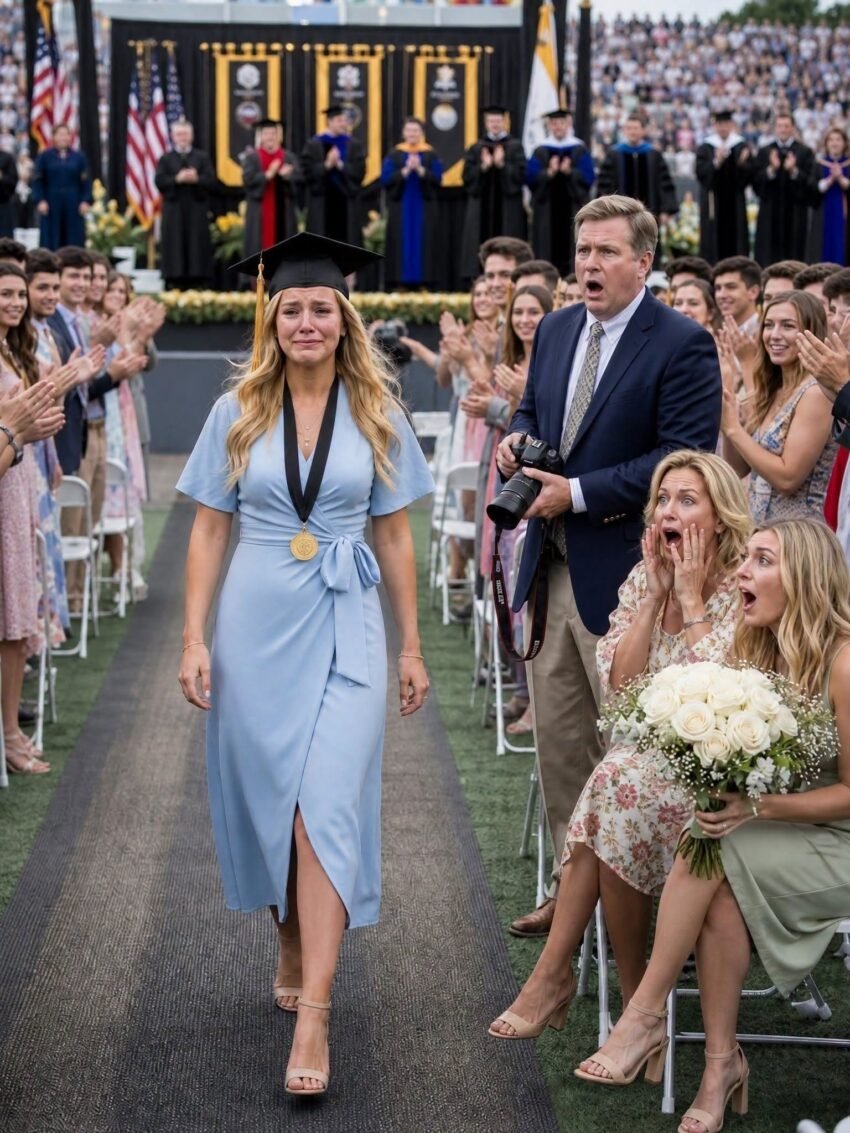
My father slid my college acceptance letter back toward me, then paid my twin sister’s tuition without a second thought. “She has a future worth investing in,” he said. “You don’t.” Four years later, my parents arrived at graduation with flowers for her and proudly took their seats in the front row—never imagining whose name the announcer was about to call across the packed stadium.
The night my father told me I wasn’t worth investing in, my twin sister Brooke was already smiling.
He sat in our living room with Brooke’s acceptance letter from Oakwood University in one hand and my letter from Cascade State in the other. He examined them as though he were comparing financial proposals instead of deciding the futures of his two daughters.
“We’re paying Brooke’s tuition,” he announced. “Her housing too. She won’t have to worry about anything.”
Brooke squealed with excitement, and my mother immediately began talking about decorating her dorm room before he had even finished. Then my father pushed my envelope across the table toward me.
“We won’t be paying for Maya,” he said without emotion. “Your sister has genuine potential, and Oakwood is an investment worth making.”
I stared at him, waiting for some sign that I had misunderstood. “Then what am I supposed to do?”
He calmly clasped his hands. “You’ll figure it out. You’ve always been good at taking care of yourself.”
That was the entire discussion. There was no apology, no reassurance and not even a moment of hesitation.
My father simply delivered his verdict in the middle of our Minneapolis living room while I held the acceptance letter representing a future he had already decided was not valuable enough to support. Brooke sat beside him grinning, as if she had just won a competition I hadn’t known we were having.
That night, I opened the outdated laptop Brooke had given me after buying a newer one and began searching for scholarships available to financially independent students. Three months later, I carried two worn suitcases into a deteriorating rental house near River Valley State and started creating a life no one in my family had offered to help me build.
My bedroom was barely large enough for a mattress and a narrow desk. Every morning, I woke at 4:30 for a coffee shop shift before attending classes, studying late into the evening and cleaning houses on weekends.
I discovered exactly how long a person could survive on instant noodles, exhaustion and stubborn determination. When Thanksgiving arrived and nearly every student left campus, I still called home.
“Can I speak to Dad?” I asked.
I heard his voice somewhere in the background, but my mother returned to the phone alone.
“He’s busy.”
That evening, Brooke posted a family photograph online. My parents were smiling beside her at a table covered with elegant dishes and glowing candles.
There were only three place settings.
The image should have broken me, but instead, it hardened the part of me that was still waiting for their approval. I stopped hoping they would suddenly recognize what they had done and focused on proving to myself that their judgment had never defined my ability.
During my second semester, I nearly collapsed in the middle of an early coffee shop shift. Two days later, my economics professor returned our assignments with an A+ written across the top of mine and a short message beneath it.
Stay after class.
I assumed I had done something wrong. Professor Robert Maxwell waited until the room emptied, tapped my paper and studied me carefully.
“This isn’t ordinary work,” he said. “Who taught you to believe you were ordinary?”
I gave a quiet laugh. “My family.”
Then I told him about the early shifts, the cleaning jobs, the rent and the constant exhaustion. I also described the night my father looked at my future and declared that I was not worth the investment.
Professor Maxwell opened his desk and removed a thick folder.
“The Vanguard Fellowship,” he explained. “Only twenty students in the country receive it each year. It covers full tuition and living expenses.”
I immediately pushed the folder away. “Something like that isn’t meant for someone like me.”
He calmly slid it back across the desk. “You’re exactly the kind of student it was created for.”
I began working on the application before my morning shifts and rewriting essays after midnight. I practiced interview answers on crowded buses, and during one particularly difficult week, I had only thirty-six dollars remaining after paying rent.
Still, I advanced to the final round.
Then I won.
I opened the acceptance email while sitting on a bench between classes, my hands trembling so badly that I could barely read the screen. But the attachment beneath the message was what truly left me breathless.
The fellowship allowed recipients to transfer to participating universities for their final academic year.
Oakwood University was one of them.
It was the same prestigious school my father had decided I did not deserve to attend. Professor Maxwell explained that transfer fellows were automatically admitted into Oakwood’s honors program and that the highest-ranking students were considered for the commencement address.
I submitted the transfer documents without telling anyone in my family.
Oakwood looked exactly like the photographs Brooke constantly posted online. Stone buildings surrounded immaculate lawns, students wore expensive coats, and nearly everyone seemed to move through campus as though opportunity had belonged to them since birth.
Brooke eventually found me inside the library. She froze several feet away, still holding an iced coffee.
“What are you doing here?”
“I transferred.”
“Mom and Dad never said anything.”
“They don’t know.”
Her gaze dropped to the stack of textbooks in my arms. “How can you possibly afford Oakwood?”
“I earned a scholarship.”
That one word changed everything.
My phone began vibrating before I reached my dorm. My mother called repeatedly, Brooke sent several messages, and one short text arrived from my father.
Call me.
I waited until the next morning to respond. He answered while I was crossing campus on my way to class.
“Your sister says you transferred to Oakwood.”
“That’s right.”
“You made that decision without telling us?”
Students moved around me as I slowed near the steps of the economics building.
“I didn’t think my education mattered to you,” I replied.
He hesitated. “Of course it matters. You’re my daughter.”
The claim sounded almost unfamiliar after years of being ignored.
“Am I?” I asked. “Because I clearly remember you saying I wasn’t worth investing in.”
Silence filled the line.
Eventually, he asked, “How are you paying Oakwood’s tuition?”
“The Vanguard Fellowship.”
Another long pause followed.
“That fellowship is extremely competitive.”
“I know.”
Then he said the one sentence that revealed nothing had truly changed.
“Your mother and I will already be attending Brooke’s graduation, so we can discuss this afterward.”
They were still coming for Brooke.
Not for me.
By the spring semester, my days were consumed by honors meetings, speech rehearsals and the careful silence required to protect my secret. Meanwhile, my parents covered Brooke’s graduation posts with messages about how proud they were of everything she had accomplished.
They still had no idea what was coming.
Graduation morning arrived beneath a warm, cloudless sky. Families poured into Oakwood Stadium carrying cameras, balloons and bouquets wrapped in crackling plastic.
I entered through the faculty gate in a black graduation gown. A gold honors sash rested across my shoulders, and a university medallion hung against my chest.
From the honors section beside the stage, I spotted my family immediately.
They occupied the center seats of the front row. My father had already aimed his camera toward Brooke’s section, while my mother held a bouquet of white roses meant for her.
Brooke sat nearby laughing with her friends and straightening her cap. All three of them looked completely certain that they knew how the ceremony would unfold.
The procession began, faculty members crossed the stage, and hundreds of names blended together beneath the afternoon sun. With every passing minute, my heartbeat grew louder.
Finally, the university president approached the podium with a card in his hand.
My father lifted his camera toward Brooke once more. My mother leaned forward, tightening her grip on the roses.