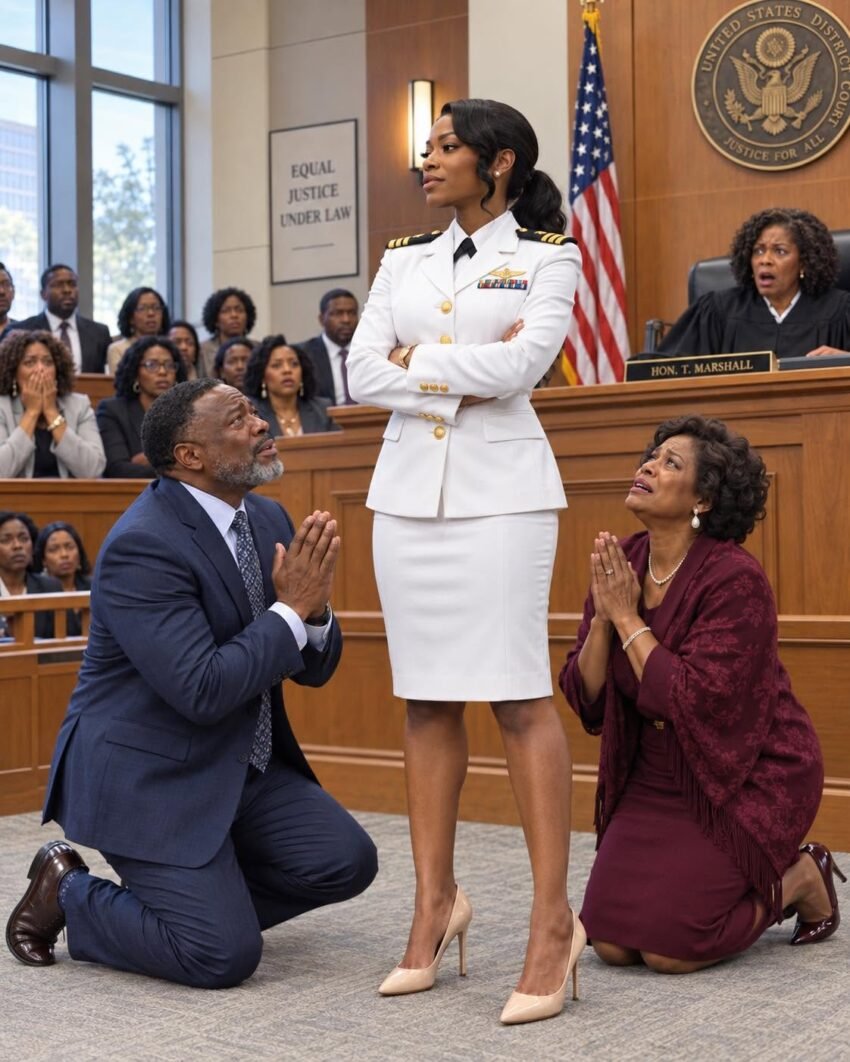
Part 2: The Moment the Judge Recognized Me
For three seconds, nobody moved.
Judge Ferro looked down at the file again, then back at me.
“Major Ardmore,” she repeated. “United States Army?”
“Yes, Your Honor.”
My father stopped moving his pen.
My mother’s fingers, which had been gripping my wrist less than twenty minutes earlier, suddenly felt very far away.
Vernon Slaught rose halfway from his chair.
“Your Honor, I’m not sure what bearing the defendant’s employment—”
“Sit down, Mr. Slaught.”
He sat.
Judge Ferro turned another page.
“I want to make sure I understand this correctly. You are currently serving on active duty, and you have been in the military for how long?”
“Fourteen years, Your Honor.”
“Fourteen years.”
She said it quietly, almost to herself.
Then she looked at my parents.
“Mr. and Mrs. Ardmore, your petition describes your daughter as financially irresponsible, socially isolated, and incapable of making sound decisions. You also state that she has no meaningful professional accomplishments.”
My father leaned toward his attorney.
“That’s what we’ve always known about her,” he muttered.
The judge heard him.
“So you have known your daughter for thirty-eight years?”
“Of course,” my father replied.
“And you were unaware of her military service?”
My mother opened her mouth, then closed it.
My father looked at the table.
That was the first moment I realized they might not have understood what they had done.
Not because they had suddenly discovered that I was successful.
But because they had just made a claim about my life in a courtroom where the facts could be verified.
Judge Ferro removed her glasses.
“Major Ardmore, I see several commendations listed in the supporting documentation. I also see records of deployments, leadership assignments, and a service history that appears inconsistent with the characterization presented by the petitioners.”
She paused.
“Would you care to explain why your parents appear to know so little about your professional life?”
I could have told her everything.
I could have explained the birthday calls that never came, the unanswered messages, the holidays I spent overseas, and the Christmas when I called home from a base thousands of miles away and my mother asked whether I could send money for my brother’s new truck.
Instead, I gave the simplest answer I could.
“Your Honor, they haven’t asked.”
My mother flinched as if I had slapped her.
“That is not true,” she said immediately. “We’ve always been concerned about you.”
Judge Ferro raised one hand.
“Mrs. Ardmore, you will have your opportunity to speak through counsel.”
My mother sat back.
For the first time that morning, she looked uncertain.
Then the judge turned to the matter that had brought us all there.
“The decedent’s estate.”
She opened the will.
“Halina Ardmore executed this document before two witnesses and a licensed attorney. The file also contains medical evaluations conducted before and after the execution date, along with a statement from the attorney who prepared the instrument.”
Vernon Slaught stood again.
“We challenge the circumstances surrounding those evaluations.”
“On what evidence?”
He hesitated.
“We believe the beneficiary exerted undue influence.”
“Do you have evidence of that influence?”
“We believe the circumstances warrant further investigation.”
Judge Ferro stared at him.
“That is not the same thing.”
My grandmother’s attorney, a silver-haired man named Arthur Bell, sat beside me. He had barely spoken all morning. Now he opened his briefcase and placed a thin envelope on the table.
“Your Honor, there is one additional document Ms. Ardmore requested that I bring today.”
The judge accepted it.
My father finally looked up.
“What document?”
Arthur Bell did not answer him.
Judge Ferro read the first page. Her expression changed—not dramatically, but enough that everyone in the room noticed.
She read the second page.
Then she looked at my parents.
“Mr. and Mrs. Ardmore, did either of you know that your mother had requested an independent assessment of her estate and family circumstances before making her final decision?”
My father frowned.
“She was old. People get confused.”
“Did you know that she met privately with her attorney on four separate occasions?”
Neither parent answered.
“Did you know that she specifically instructed him to document any attempts by relatives to pressure her regarding her assets?”
My mother’s face lost its color.
I looked at Arthur Bell.
He gave me the smallest nod.
My grandmother had anticipated this.
Not the lawsuit, perhaps. Not every accusation or every ugly scene in a courthouse corridor.
But she had anticipated that someone might refuse to accept her decision.
Judge Ferro continued reading.
Then she reached the final page.
“Mr. Slaught, I would like you to explain something to me.”
He stood slowly.
“Yes, Your Honor?”
“Your petition states that the beneficiary manipulated the decedent into disinheriting her family. Yet this document, signed several months before the will, appears to describe the decedent’s reasons for making precisely that decision.”
My father stood abruptly.
“This is ridiculous. My mother would never have wanted to leave everything to her!”
“Sit down, Mr. Ardmore.”
“She was my mother!”
“And she was an adult with the legal right to decide what happened to her property.”
The judge’s voice remained calm, which somehow made it more powerful.
“Unless you can establish a valid legal basis for setting aside her will, your personal disagreement with her decision is not sufficient.”
My father sat.
I watched him stare at the papers as though the words might rearrange themselves into something he could understand.
Then Judge Ferro asked Arthur Bell to read the relevant passage aloud.
He adjusted his glasses.
“Mrs. Halina Ardmore stated that she wished to leave her estate to her granddaughter because, in her words, ‘She was the only person who never asked me what I could give her. She asked me what I needed.’”
My throat tightened.
I remembered the winter my grandmother broke her hip.
I had been a young officer then, home on leave for less than a week. My parents had visited her once. My brother had sent flowers. My sister had called to ask whether Grandma planned to change her will.
I had stayed.
I helped her wash her hair. I learned how she liked her tea. I sat beside her bed when the pain kept her awake.
When I left, she pressed a small envelope into my hand.
Inside was a photograph of us sitting on her porch.
On the back, she had written, You see me, sweetheart. Never let anyone convince you that isn’t worth something.
I had kept that photograph in my desk for eleven years.
My grandmother had never told me she planned to leave me anything.
I had never asked.
Arthur continued reading.
“‘I have watched my family measure affection by inheritance, attention by usefulness, and respect by money. My granddaughter has never treated me as an account to be divided. I want her to have the freedom to build a life in which she does not have to ask anyone’s permission to exist.’”
Nobody spoke.
I stared at the table because I didn’t trust myself to look at my parents.
Then my mother whispered, “She never said that to us.”
Judge Ferro looked at her.
“Perhaps she felt she could not.”
My mother began shaking her head.
“No. No, that’s not fair. We were her family.”
Arthur Bell placed the document down.
“Mrs. Ardmore, your mother also recorded her reasons for excluding other relatives from the estate. The statement is quite specific.”
My father’s attorney reached for the paper.
“Your Honor, we’d request time to review this material.”
“You may review it,” the judge said. “But I want to address another matter first.”
She looked directly at my mother.
“Court security has reported that you physically grabbed your daughter’s wrist in the corridor this morning. Is that accurate?”
My mother turned toward me.
For the first time in my life, she seemed to be waiting for me to rescue her.
I said nothing.
“Mrs. Ardmore?”
“I was trying to make her listen.”
“Did she give you permission to grab her?”
My mother stared at the floor.
“No.”
“Then you should not have done it.”
The judge turned to the court officer and instructed him to document the incident.
It was a small thing. A note in a file. A formal acknowledgment that something had happened.
But I had spent thirty-eight years hearing that things hadn’t happened the way I remembered them.
For once, somebody had seen it.
Somebody had written it down.
And nobody had asked me to pretend it was nothing.
Judge Ferro recessed the hearing for twenty minutes.
In the corridor, my father approached me while my attorney was speaking with Arthur Bell.
“Why didn’t you tell us?” he demanded.
I looked at him.
“Tell you what?”
“That you were a major.”
“You never asked what I did.”
“You could have told us.”
“I sent you my promotion announcement.”
He blinked.
“Years ago,” I continued. “I sent you a photograph in uniform. I called when I received my first command assignment.”
My mother joined us.
“We thought you were trying to make us feel guilty.”
I almost laughed.
Not because it was funny, but because it explained so much.
Every achievement had been interpreted as an accusation. Every boundary had been called disrespect. Every time I built a life beyond their reach, they treated it as a personal insult.
My father lowered his voice.
“Look, whatever happened in there, we’re still your parents. We can settle this privately. You withdraw the objections, we withdraw the lawsuit, and we can all move forward.”
I stared at him.
“You sued me for my grandmother’s money.”
“We were protecting the family.”
“No. You were trying to take something she deliberately gave me.”
My mother stepped closer.
“Don’t make this uglier than it has to be.”
I looked at the hand that had gripped my wrist that morning.
“You did that in front of twenty people. You called me worthless in a courthouse. And now you want me to make this easier for you?”
She said nothing.
I reached into my folder and removed the photograph of my grandmother.
I had brought it because I needed something to hold on to that morning.
I didn’t show it to them.
I simply slipped it back into the folder.
“My grandmother knew who I was,” I said. “That’s why she chose me.”
Then I walked back into the courtroom.
The hearing resumed shortly afterward.
Judge Ferro reviewed the will, the medical records, the attorney’s sworn statement, and the evidence submitted by both sides. My parents’ attorney had no witness who could testify that I had pressured my grandmother. They had no credible evidence of incapacity. Their petition relied largely on suspicion, family grievances, and the argument that the inheritance was too large for someone like me.
Someone like me.
By the time the judge finished reviewing the file, that argument had collapsed under the weight of the evidence.
She denied their request to invalidate the will and rejected their application to freeze the inheritance. She ordered the estate proceedings to continue according to the valid testamentary documents, subject to the remaining administrative requirements.
The lawsuit itself was not transformed into a complete victory over every possible issue that afternoon. There were still legal fees, paperwork, and questions about the costs of the proceedings.
But the central question had been answered.
My grandmother’s decision stood.
Outside the courtroom, my father didn’t look at me.
My mother did.
“You’ve changed,” she said.
I considered that.
Perhaps I had.
I had learned to lead people through difficult situations. I had learned to make decisions when everyone around me was frightened. I had learned that love did not require me to surrender my dignity to prove I deserved it.
But I hadn’t become the person they saw that morning.
I had been that person all along.
They had simply never bothered to look.
Three weeks later, I visited my grandmother’s grave.
I brought white roses and the photograph from my folder. The afternoon was cool, and the cemetery was quiet except for the sound of leaves moving through the trees.
I stood there for a long time.
“I won, Grandma,” I whispered.
Then I corrected myself.
“I think you won.”
Because the money was never the thing I wanted most.
It was the knowledge that someone had seen me clearly, without asking me to become smaller, quieter, or more convenient.
Someone had believed that the life I built belonged to me.
I left the roses beside her headstone and walked back to my car.
My phone buzzed before I reached it.
A message from my mother.
We need to talk. We’re still family.
I read it once.
Then I put my phone away.
Family, I had finally learned, was not a title that gave someone ownership over your life.
It was a relationship built through care, honesty, and respect.
My grandmother had understood that.
And for the first time in thirty-eight years, I didn’t need my parents to understand it too.
The inheritance was mine. My life was mine. And the next decision would finally be mine to make.