Elise Kensington stood at the mouth of the aisle, a glass of champagne resting lightly in her gloved hand. She was talking to the pastor, smiling that practiced, half-closed smile that signaled complete control.
When the double doors creaked open, her expression didn’t change at first. She was expecting a weeping bride, or perhaps an panicked maid of honor declaring a delay.
Instead, the soft hum of two hundred conversation-filled guests died in a single, collective gasp.
My father and I stepped into the sunlight streaming through the Conservatory’s glass roof. Every head turned. The string quartet’s violins faltered, falling into an awkward, dying screech before stopping completely.
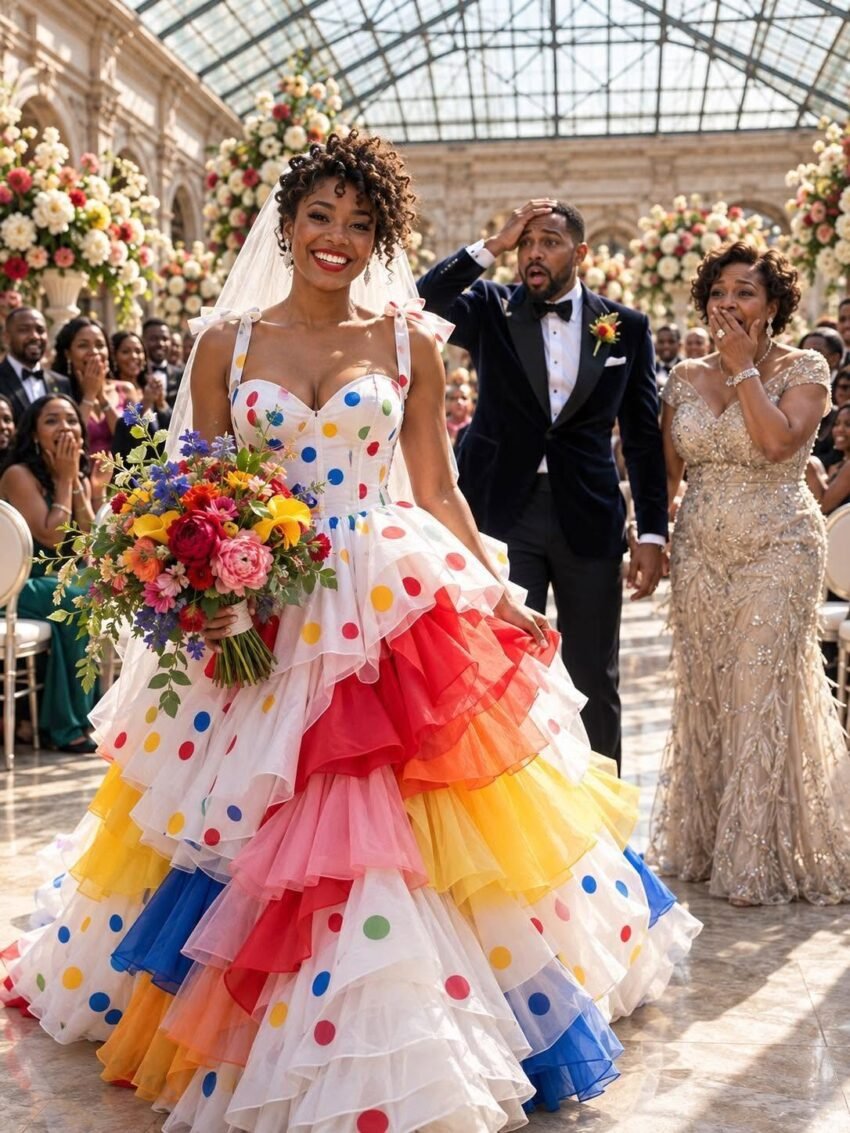
I walked down the aisle in a clown suit, every rutilant red, yellow, and blue ruffle rustling with each step. My father held his head as high as if he were walking a princess down the carpet, his polished brass valve pin gleaming on his lapel.
Elise’s jaw went completely slack. The champagne glass in her hand tilted, dripping expensive bubbles onto the marble floor.
In the front row, Bennett turned. His face went through five distinct emotions in three seconds: confusion, embarrassment, horror, and finally, a deep, furious blush that crept up his neck.
“Clara?” Bennett gasped, taking a step forward. “What… what are you doing? What is this?”
I didn’t answer him. I didn’t look at him. I kept my eyes fixed entirely on Elise.
I stopped at the altar. The silence in the room was so heavy you could hear the air conditioning vents humming above us. Two hundred people sat frozen—Gladwyne society, high-court judges, patent attorneys, and family friends—staring at a bride dressed as a circus act.
“Elise,” I said, my voice carrying clearly through the glass structure. “I wanted to make sure I wore what you selected for me.”
Elise recovered her composure instantly, her mouth pulling into a tight, venomous line. She took two steps forward, lower lip trembling with rehearsed horror.
“Clara, darling…” Elise stammered, looking at the surrounding guests with a masterclass in faux concern. “Oh, dear heaven. We knew you were stressed, but… to break down like this on your special day? Bennett, call her doctor. She’s had a breakdown.”
“I didn’t break down, Elise,” I said calmly. “You took my dress.”
A murmur rippled through the crowd.
“Don’t be absurd!” Elise snapped, her tone dripping with pity. “Why on earth would I do that? You’ve clearly misplaced it in your state. Look at you—you’re hysterical!”
“You left a note,” I said, reaching into the hidden pocket of my oversized costume ruffles. I pulled out the gold-edged Smythson card and held it out. “Cream paper. Gold leaf border. ‘Know your place.’ Written in your handwriting.”
Bennett stared at the card, then at his mother. “Mom? What is she talking about?”
“She’s lying!” Elise hissed, though a flash of genuine panic flickered across her eyes. “She wrote that herself to humiliate this family! Look at her, Bennett! She’s trying to ruin your life!”
“I don’t need to ruin your family, Elise,” I said quietly. “You did that yourself twenty-seven years ago.”
I reached for my bridal clutch, which my father gently handed to me. I pulled out the black folder.
“Forty minutes ago, I was going to hide this,” I said, speaking to the entire room now. “I was going to sign over my share of the patent rights to Kensington Medical Devices as a wedding gift to Bennett, so your family’s firm could finally go public next month.”
Bennett blinked. “What rights? What are you talking about?”
“Your father’s company,” I said, turning to Bennett, “was built on the Kensington Micro-Valve—the micro-catheter valve that made your grandfather and your mother multi-millionaires. The valve that funds your Gladwyne estate, your Hamptons house, and that Birkin bag on your mother’s arm.”
Elise went pale. Her knuckles turned white as she clutched her handbag. “Clara, stop this madness immediately. Security—”
“My mother, Helen Dalton, wasn’t just a lab assistant,” I continued, my voice echoing off the glass walls. “She was the lead engineer on the 1997 micro-valve prototype at Penn Health. Your late father didn’t invent it, Elise. He stole the schematics from her desk three weeks before she was forced out of her lab.”
The room erupted into hushed, intense whispering.
“That’s a lie!” Elise screamed, her polished composure completely shattering. “You have no proof!”
“March 4, 1997,” I said, opening the black folder. “A notarized co-development assignment signed by Arthur Kensington, acknowledging Helen Dalton’s 50% proprietary ownership of the core fluid-dynamics design. My father kept it in his safe for nearly thirty years.”
I pointed to the brass pin on my father’s lapel. “He wears the original brass prototype every single day.”
Bennett looked like he’d been struck by lightning. He turned to his mother, his voice cracking. “Mom… is that true? Is that why the legal audit for the IPO was delayed last week?”
Elise didn’t answer. She couldn’t. The truth was written all over her face.
“My mother died without a penny of the credit or the billions your family made off her work,” I said, looking Elise dead in the eye. “I was going to let it go, Bennett. I loved you enough to believe we could start fresh. But your mother reminded me today that I need to ‘know my place.'”
I took the eleven notarized pages from the folder and held them up.
“My place isn’t in your family,” I said. “My place is as the majority rights-holder of Kensington Medical Devices.”
I looked at Bennett, who was staring at me in absolute horror—not because of the costume, but because he realized his entire life, his fortune, and his family’s reputation had just evaporated in front of two hundred of Philadelphia’s most prominent elite.
“The wedding is off,” I said softly.
I handed the black folder to my father, took off the yellow clown shoes, and stepped out of them in my plain white heels.
I turned around, took my father’s arm once more, and walked back up the aisle, leaving the ruffles behind on the marble floor.
As the glass doors closed behind us, the room erupted into total chaos.
EPILOGUE
Three months later, The Philadelphia Inquirer ran a business section cover story on the restructuring of Kensington Medical.
Following a federal patent review and an emergency court settlement, fifty percent of the company’s core technology patents were officially reassigned to the Helen Dalton Estate. To avoid criminal fraud charges and bankruptcy, the Kensington family was forced to liquidate three of their private estates and surrender control of the board.
I never spoke to Bennett again, though he tried calling thirty-seven times the week after the wedding.
My father and I used our first royalty distribution to launch the Helen Dalton Foundation for Female Engineers, funding full university scholarships for young women from working-class backgrounds.
And as for my wedding dress?
Two days after the incident, a courier delivered a heavy box to my apartment. Inside was my custom Vera Wang gown, neatly folded, along with a tear-stained, desperate apology letter from Elise, begging me to reconsider legal action.
I didn’t answer the letter.
Instead, I donated the dress to a local bridal charity for women who couldn’t afford one—and kept the clown costume hanging in my closet, right where I could see it every day.