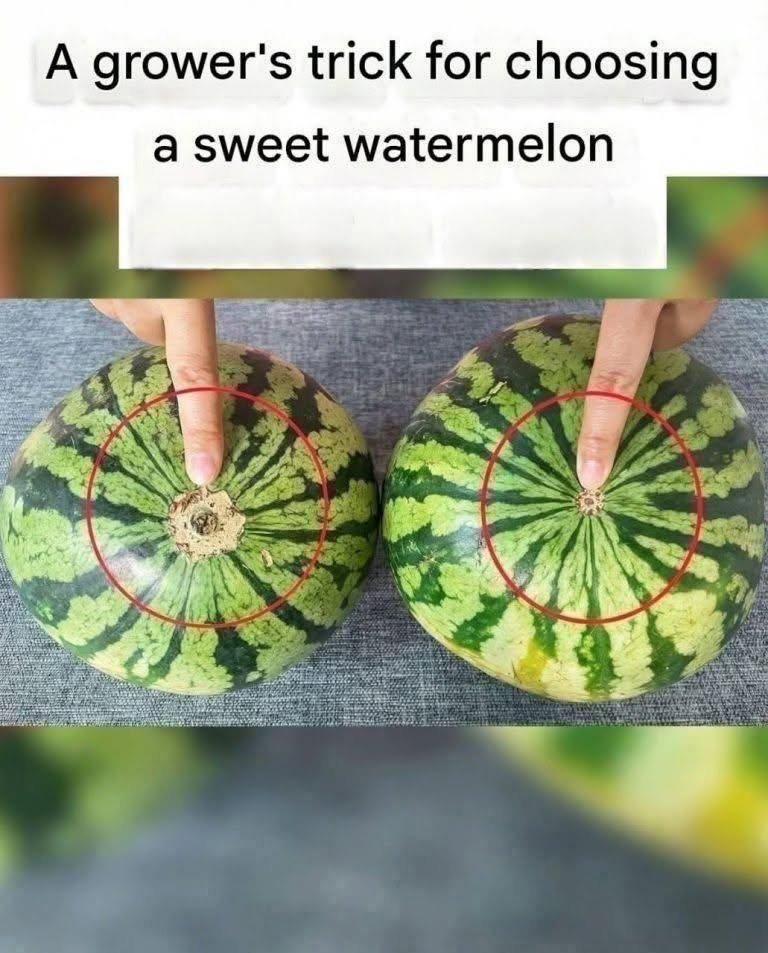
🍉 No More Bland Watermelons! Here’s a Sure-Fire Visual Guide to Finding the Sweetest Fruit at the Market
There’s nothing more disappointing than bringing home a beautiful watermelon, cutting it open, and discovering that it’s pale, watery, and almost tasteless.
The good news? You can learn a few simple visual clues that can help you choose a better watermelon before you ever cut it open.
1. Look for a large, creamy-yellow field spot
Turn the watermelon over and look for the large discolored patch where it rested on the ground while growing.
A creamy yellow or orange-yellow spot is generally a better sign than a very pale white or greenish one. It indicates that the melon spent time resting on the ground as it matured.
Don’t automatically reject a watermelon because of a small field spot, though. Shape, firmness and overall appearance matter too.
2. Choose a watermelon that feels heavy
Pick up several melons that are approximately the same size.
Choose the one that feels heaviest for its size.
Watermelon is mostly water, so a heavy melon is often a good indication that it has plenty of moisture inside.
This is one of the easiest tests to use when you’re standing at the market.
3. Look for a dull, rather than shiny, rind
A perfectly glossy watermelon can look attractive, but when choosing between similar melons, a duller, slightly matte rind can be a useful maturity clue.
A watermelon that’s still very shiny may not have reached the same level of maturity.
4. Check the shape
Look for a watermelon that is:
- Firm
- Symmetrical
- Evenly shaped
- Free from major bruises or soft spots
Large irregular dents, cuts, leaking areas or mushy sections are reasons to choose another melon.
A perfectly round watermelon isn’t automatically sweeter, however. Different varieties naturally have different shapes.
5. Don’t obsess over the brown “webbing”
You may have seen viral posts claiming that extensive brown web-like markings guarantee an exceptionally sweet watermelon.
That’s not a reliable rule.
The markings can occur for several reasons and aren’t a dependable sweetness meter by themselves.
So if you find a watermelon with beautiful webbing but it feels light and has a poor field spot, don’t assume the webbing makes it the winner.
6. The stem can offer another clue
If the watermelon still has a visible stem, look at its color.
A dried, brownish stem can indicate that the fruit was allowed to mature before being harvested.
A very green stem may indicate that it was harvested earlier.
However, many store-bought watermelons have little or no useful stem remaining, so don’t make this your only test.
7. Give it a gentle tap—but don’t rely on sound alone
You’ve probably seen people knocking on watermelons at the grocery store.
The traditional idea is that a ripe watermelon should produce a deep, resonant sound.
Sound can be difficult to judge consistently, though, especially if you’re inexperienced.
Use tapping as a secondary clue, not a magic sweetness detector.
🍉 The 10-Second Watermelon Test
When you’re standing in front of a pile of watermelons, remember:
Heavy + creamy-yellow field spot + firm + symmetrical + no major damage.
That’s a much better strategy than simply choosing the biggest or prettiest melon.
And here’s the most important secret:
No visual trick can guarantee sweetness.
Variety, growing conditions, maturity at harvest and storage all affect flavor. But by combining several clues instead of relying on one viral “secret,” you can greatly improve your odds of bringing home a juicy, delicious watermelon.
So next time you’re at the market, don’t just grab the first green melon you see.
Pick it up. Turn it over. Check the field spot. Feel its weight. Inspect the rind.
Your future summer snack will thank you. 🍉