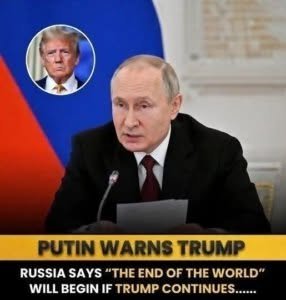
Russia Warns of the “End of the World” if Trump Follows Through on Greenland Threat
A dramatic warning from Moscow has reignited fears about how quickly tensions between the United States and Russia could escalate.
In January 2026, Russian politician Dmitry Rogozin warned that Donald Trump’s ambitions regarding Greenland could have catastrophic consequences if they involved establishing a U.S. nuclear presence on the island. Rogozin, a former Russian deputy prime minister and former head of Russia’s space agency, described such a development as potentially leading to “the beginning of the end of the world.” (UNILAD Tech)
The comments came amid Trump’s repeated statements that Greenland is strategically important to U.S. national security and his insistence that the United States should acquire the territory, which is an autonomous part of the Kingdom of Denmark. Trump has argued that Greenland is vulnerable to Russian and Chinese influence and has refused to completely rule out using force to achieve U.S. objectives.
Why Greenland matters
Greenland occupies an exceptionally strategic position between North America and Europe. Its location makes it important for missile-warning systems, Arctic military operations, shipping routes and broader competition between major powers.
That strategic importance is precisely what makes the rhetoric surrounding the island so concerning.
Rogozin argued that placing American nuclear forces there could alter the strategic balance between the United States, Russia and China. His warning was framed around the possibility of a confrontation escalating into a nuclear conflict—not as a prediction that the world would literally end if Trump pursued Greenland. (End Time Headlines)
A warning—or political pressure?
It is important to put the statement in context.
The “end of the world” language came from a Russian political figure and was reported amid an already heated dispute over Greenland. It should not be interpreted as an official declaration that Russia intends to launch a nuclear war.
Nevertheless, the comments demonstrate how seriously Moscow views potential changes to the Arctic military balance.
The episode also highlights a broader danger: when major nuclear powers use increasingly extreme rhetoric, even a territorial dispute can become entangled with fears of a much larger confrontation.
For now, the Greenland dispute remains primarily a geopolitical and diplomatic confrontation. But with the United States, Russia and China all competing for strategic influence in the Arctic, the island has become far more than a remote frozen territory.
It has become one of the world’s most closely watched geopolitical flashpoints.