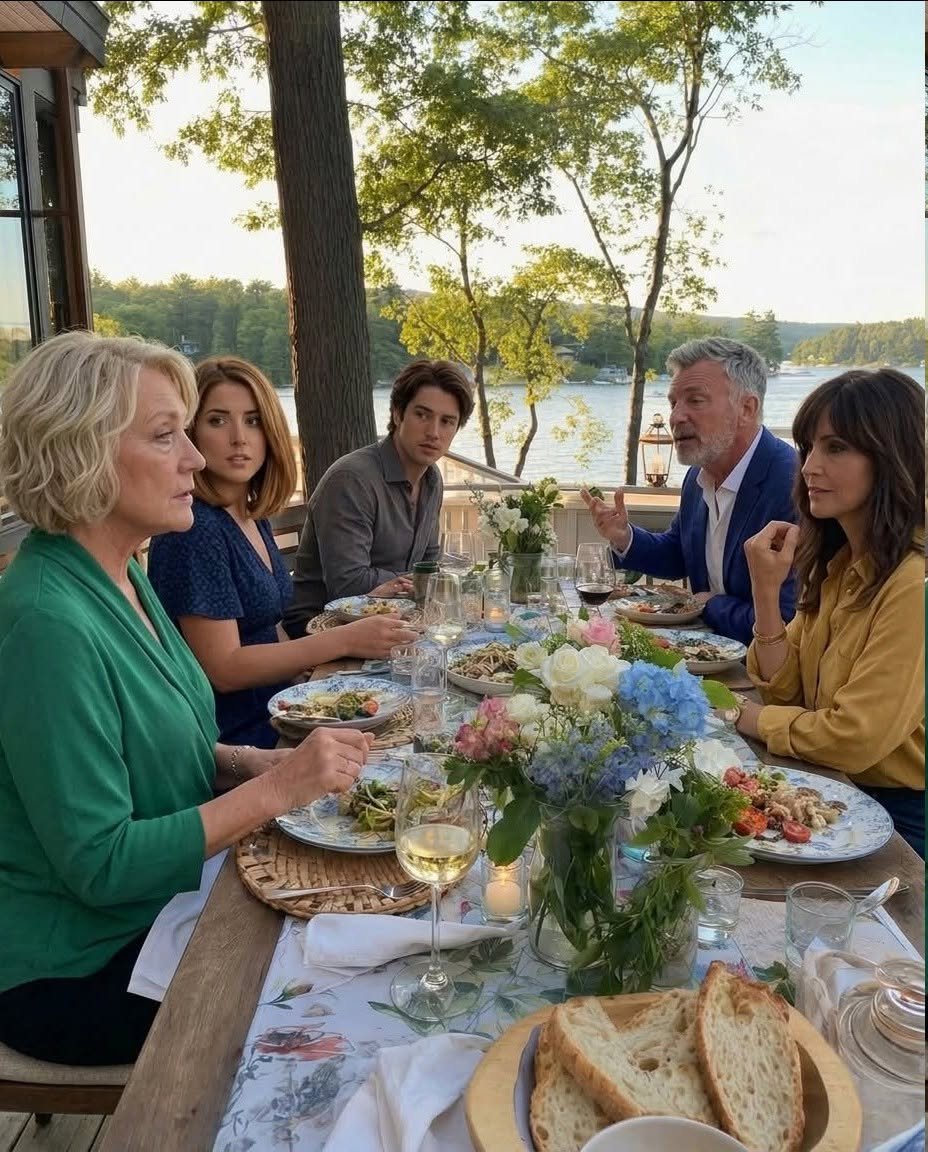
They Thought I Couldn’t Understand French—Until I Answered
Then, in effortless French, I said:
“Please don’t worry, Philippe. Your French is quite good. I understood every word.”
The room went completely silent.
Claire’s eyes widened.
Luca froze with his glass halfway to his mouth.
Hélène stared at me as though I’d suddenly begun speaking another language.
Philippe slowly lowered his fork.
“You speak French?”
I smiled.
“I do.”
For a moment, nobody knew what to say.
Then Hélène laughed nervously.
“Oh, Margaret. We had no idea.”
“I know.”
My voice was calm.
“That was rather obvious.”
Claire looked at me.
“Mom?”
I turned toward her.
“I lived in Lyon for eight years.”
Her mouth fell open.
“You lived in Lyon?”
I nodded.
“When I was twenty-two, I moved there by myself.”
She stared at me.
“Why didn’t you ever tell me?”
“I suppose I forgot how.”
That answer surprised even me.
Because it was true.
I’d spent so many years allowing other people to define what parts of me were acceptable that I’d forgotten how many parts I’d hidden.
Philippe cleared his throat.
“I apologize if anything was misunderstood.”
“Nothing was misunderstood.”
I looked directly at him.
“I understood you perfectly.”
His face reddened.
Hélène reached for her wine.
“Margaret, we were simply discussing differences in background.”
“No,” I said gently. “You were discussing my daughter as though she weren’t sitting at the table.”
Claire looked down.
I could see that she was embarrassed.
Not because of me.
Because she was hearing, for the first time, what Luca’s parents truly thought of her.
I continued.
“You called her simple.”
Hélène opened her mouth.
I raised my hand.
“Please. Let me finish.”
It was the first time I’d ever said those words at a family dinner.
And nobody interrupted me.
“You said she lacks refinement. You questioned whether she has enough cultural knowledge to raise children properly. And you suggested that Luca might spend his marriage compensating for her limitations.”
Philippe looked uncomfortable.
“That is not what I meant.”
“It is exactly what you meant.”
I looked at Claire.
“And you were wrong.”
Claire blinked.
I reached across the table and took her hand.
“My daughter is one of the most intelligent people I’ve ever met.”
She tried to smile.
I continued.
“She built a career from nothing. She moved to Boston alone. She taught herself how to run a business. She learned to cook French food because she wanted to make your son feel at home.”
Luca looked down.
Claire squeezed my hand.
“And she did all of that,” I said, “without ever needing to announce how impressive she was.”
Hélène’s expression softened slightly.
“I think perhaps there has been a misunderstanding between our families.”
“There has.”
I took a breath.
“But it isn’t about culture.”
I looked at Philippe.
“It is about respect.”
Nobody spoke.
Outside, the lake was perfectly still.
Then Luca finally put down his glass.
“Papa.”
Philippe looked at him.
“I heard everything.”
His father’s expression changed.
Luca continued in French.
“And I am ashamed that you spoke about Claire that way.”
Hélène stared at her son.
“Luca—”
“No.”
His voice remained quiet.
“But you need to listen.”
He looked at both of his parents.
“Claire is not less cultured because she doesn’t behave like you. She isn’t less intelligent because she doesn’t discuss art galleries at dinner. And she isn’t less worthy because her mother didn’t come from the same background as us.”
I felt tears beginning to burn behind my eyes.
Luca reached for Claire’s hand.
“I love her.”
Then he looked at me.
“And I am beginning to understand her mother a little better.”
Claire smiled through her tears.
Philippe sat back.
For the first time that evening, he looked uncertain.
Not angry.
Not superior.
Just uncertain.
Hélène was the first to speak.
“Margaret, where in Lyon did you live?”
I almost laughed.
It was such a simple question.
Yet something about it felt important.
“Near Croix-Rousse.”
Her eyebrows rose.
“Really?”
I nodded.
“For eight years.”
“What did you do there?”
“I taught English. Waitressed for a while. Translated documents. Helped a friend run a small shop.”
Philippe looked surprised.
“You were a teacher?”
“Yes.”
“What subject?”
“History.”
He stared at me.
“I didn’t know.”
“I know.”
There was another silence.
This one felt different.
Less hostile.
More uncomfortable.
Hélène looked at Claire.
“I owe you an apology.”
Claire didn’t respond immediately.
Then she said quietly, “Yes, you do.”
I almost smiled.
That was my daughter.
Straightforward.
No performance.
No unnecessary cruelty.
Just the truth.
Hélène nodded.
“I am sorry.”
Philippe looked at me.
“And you as well.”
I held his gaze.
“Thank you.”
Dinner continued.
It wasn’t exactly comfortable.
But it was honest.
And for the first time in decades, I didn’t feel responsible for making everyone else comfortable.
Later that evening, I stepped outside onto the deck.
The moonlight stretched across the lake.
Claire joined me.
She leaned against the railing.
“Mom.”
“Hmm?”
“You really lived in Lyon for eight years?”
I laughed.
“Yes.”
“And you speak French like that?”
“Apparently.”
She smiled.
“Why did you never tell me?”
I looked out across the water.
“Because I became so accustomed to being your mother that I forgot I had once been a woman with her own story.”
Claire was quiet.
Then she hugged me.
“You should tell me everything.”
I hugged her back.
“I will.”
The next morning, Hélène found me in the kitchen.
She was holding two cups of coffee.
She handed me one.
“I would like to hear about Lyon,” she said.
I smiled.
“Are you sure?”
“Yes.”
She hesitated.
“And perhaps you could teach me some American expressions.”
I laughed.
“Only if you teach me some Belgian French.”
She smiled.
“Deal.”
It wasn’t a magical transformation.
People don’t change overnight because someone catches them being rude.
But something had shifted.
They had finally seen me.
Not as Claire’s mother.
Not as the quiet divorced woman who arrived carrying flowers and bread.
Not as someone whose life could be measured by the size of her house, her accent, or her social connections.
They saw Margaret.
The woman who had once moved across an ocean alone.
The woman who had learned another language from scratch.
The woman who had built a life, lost parts of herself, and was finally beginning to reclaim them.
And that afternoon, when we packed our bags to leave, Claire hugged me again.
“Mom?”
“Yes?”
“I’m glad you said something.”
I smiled.
“So am I.”
For most of my life, I had confused being kind with being silent.
I thought keeping the peace meant swallowing my opinions.
I thought making myself smaller made other people more comfortable.
But silence isn’t always kindness.
Sometimes, silence simply teaches people that they can overlook you.
That evening, I didn’t raise my voice.
I didn’t insult anyone.
I didn’t make a scene.
I simply spoke the truth in a language they never expected me to understand.
And for once, I didn’t make myself invisible.
I sat at the table.
I looked everyone in the eye.
And I let them see me.